
Cable Construction & Cable Selection-Part:1
CABLE CONSTRUCTION & CABLE SELECTION- PART:1
CABLE CONSTRUCTION:
Parts of Cable:
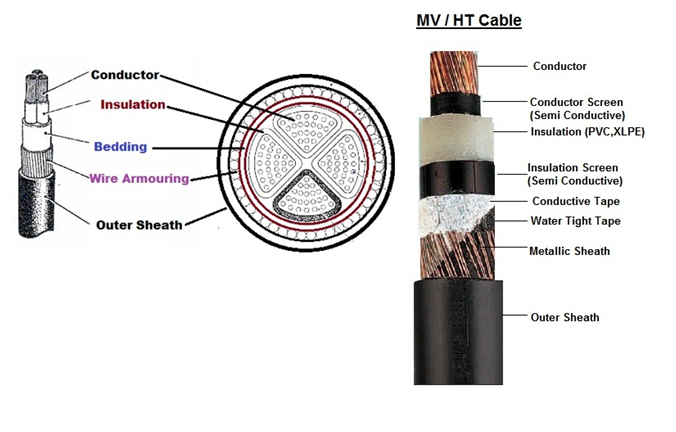
- Conductor (For LV/MV/HT Cables) 2. Conductor Screen (For MV/HT Cables) 3. Filler & Binding Tapes (For LV/MV/HT Cables) 4. Insulation (For LV/MV/HT Cables) 5. Insulation Screen (For MV/HT Cables) 6. Separation Tape (For MV/HT Cables) 7. Bedding (Inner Sheath) 8. Metallic Sheen (For MV/HT Cables) 9. Armor (For LV/MV/HT Cables) 10. Outer Sheath (For LV/MV/HT Cables) 11. Water Blocking Tapes –Optional (For MV/HT Cables) 12. Insulation Tapes–Optional (For MV/HT Cables)
Untitled
(1) CONDUCTORS:
- Code: IS:8130 / IEC 60228/ BS 6360 * Material: Class 2 – Annealed Plain / Tinned Copper / Aluminum. * Used for : LV ,MV & HV Cables * Purpose: * Usually stranded copper (Cu) or aluminum (Al) is used. * Copper is denser and heavier, but more conductive than aluminum. * Electrically equivalent aluminum conductors have a cross-sectional area approximately 1.6 times larger than copper, but half the weight. * The size of the copper / Aluminum conductor forming one of the cores of a cable is expressed in square millimeters (mm2), and the current rating of the cable is dependent upon the cross-sectional area of each core. * Multi core Aluminum or copper conductor are produced by two Shapes * Circular Conductor: multi layers of stranded wires are assembled together to make circular shape. * To achieve a circular conductor, the number of strands follows a particular progression: 3, 7, 19, 37, 61, and 127 etc, the diameter of each strand being chosen to achieve the desired cross-sectional area of whole conductor. * Circular Shape conductor is normally available used up to 200mm2 * Segment Conductor: Five segments of compacted conductor in triangle shape of 72 degree are assembled together with separation of non metallic tapes to reduce the skin effect which reduce the AC conductor resistance. * Larger sizes have conductors with the strands laid up in a segmental formation; this Cables achieves a better space factor and reduces the overall diameter of the cable. It also reduces the inductance of the cable due to decreased spacing between phases * Segmental conductor is normally available from 1000 mm2 and above
(2) CONDUCTOR SCREEN (SEMI CONDUCTOR SCREEN):
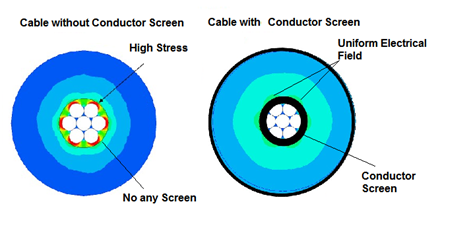
- Code: IS:7098/IEC:60502/ BS:6622/BS:7835 * Material: Extruded thermo set semi-conducting compound, Carbon paper and carbon loaded polymer. * Used for : Cable from 6 to 30kV (MV & HV Cables) * Purpose: * This screen consists of a lapped copper tape or metallic foil usually less than 1.0mm in thickness, which is the interface between the conductor and the insulation (PVC, XLPE). * The Main Purpose of Conductor Screen is to maintain a uniformly divergent electric field, and to contain the electric field within the cable core. * Conductor Screen is semi-conducting material because Semi-conducting materials do not conduct electricity well enough to be a conductor but will not hold back voltage. It “smoothes” out the surface irregularities of the conductor. The conductor shield makes the voltage on the inside of the insulation the same * Semiconducting screening materials are based on carbon black that is dispersed within a polymer matrix. The concentration of carbon black needs to be sufficiently high to ensure an adequate and consistent conductivity. * The incorporation must be optimized to provide a smooth interface between the conducting and insulating portions of the cable. * The smooth surface is important as it decreases the occurrence of regions of high electrical stress. * Control Electrical Field: Conductor Screen is control the electric field within the insulation and thus the same voltage gradient across it. It also avoids any interaction of the electric stresses due to the voltages on different phase conductors within the same cable. * Reduce Voltage Stress Conductor Screen helps to reduce voltage stress at the interface between the conducting and insulating components. * A typical construction for a medium voltage cable consists of an aluminum conductor covered by a screening layer, then by a polyethylene or ethylene propylene rubber insulation followed by a further screening layer. The coefficient of expansion of the insulation layer is typically ten times greater than that of the aluminum and when the cable is at its maximum operating temperature of 90ºC, a large enough gap can formed to allow electrical discharges to occur. The semi-conducting layer then serves to even out the stresses associated with these discharges, which would otherwise attack the insulation at specific points.
e
- Uniform Electrical Field: A Black semi-conducting tape is used to maintain a uniform electric field and minimize electrostatic stresses in MV…