
Method for Installation of Cable & Wire (Part-2)
METHOD FOR INSTALLATION OF CABLE & WIRE (PART-2)
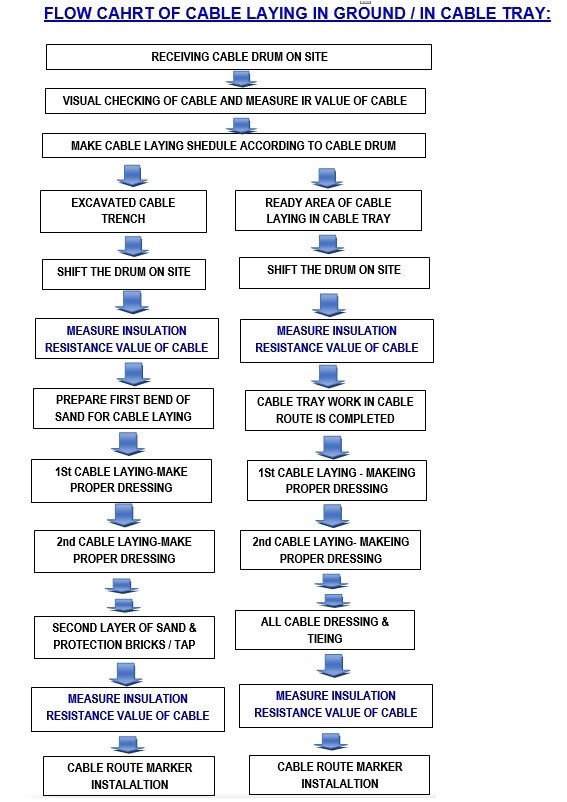
(A) CABLE LAYING IN EXCAVATED GROUND:
(A) FORMATION OF CABLE TRENCH.
- Check the area of excavation by referring As Built drawing to find out crossing of any underground Services i.e. Gas Line, Water Line or other Cable. Check the indication marks, signs, manholes nearby area and find out the path of old services. * If there are structures adjacent to the work area, proper temporary supports shall be provided to the adjacent structure prior to start excavation. * Excavation near the existing electrical cables, instrumentation and control cables, sewer line, gas lines and any other service line shall take all necessary precautions to protect the services with proper supports & covers. * Ensure the working area at any confined space is free from any Hazardous Gas by proper Gas testing using the Gas testing instrument. * Required sign boards such as “DEEP EXCAVATION” “MEN WORKING”, “DANGER” and warning boards will be placed to indicate the excavation work. The area of excavation will be cordoned by using safety barricading to stop trespassers. * In open areas the excavation shall be carried out by using the machineries. * If the excavation level is below the local water table level suitable dewatering system shall be designed and installed in such a way that alterations and extensions to the system during operations are possible. * The width of the excavated Cable trench shall be as per specification or as per approved Drawings. * The trench shall be excavated up to the required depth of 0.76 Meter from the existing ground level or as per Specification or as per approved Drawing. * The Cable trench shall be kept dry during cable installation operation. The contractor shall deal with the dispose of water so as to prevent any risk to the cables and other materials. * Debris, rocks and unusable materials shall be removed from Excavated Trench on daily basis and it will dump at the approved dumping Location of from the site.
(B) FIRST LAYER OF SAND:
- The bottom of the trench shall be backfilled with a layer of clean and fine sand bedding of 100mm thickness or as per the approved Drawing. * The fill material shall be tamped. Any hard material which could damage the cable will be removed * Inspection of sand bed will be carried out prior to commencement of cable pulling.
(C) CABLE LAYING:
- Cables are laid over the clean and fine First Layer of sand bedding. * Rollers must be used where cables are installed in an open trench using a pulling rope and eye; cable rollers are to be used at frequent intervals to support the cables and must never be more than 3 meters apart. * Care must be taken to ensure that the cable does not enter or leave the rollers at an angle that exceeds the bending radius of the cable. * The Pulling rope must be attached to the cable by a stocking grip with pulling eye. * The cable shall be drawn into the trench manually, before the pull commences, to prevent the winch to move along with the cable. * The cable shall be drawn into the trench smoothly with a minimum of stops and at an average speed of between 9 to 12 meters per minute, to avoid irregular movement. * Cables shall be arranged properly to minimize crossovers, twists. * All Cable shall be laying parallel to each other and cable dressing should be done properly * Cable identification tags shall be installed on both end of cable after the cable pulling.
(D) SECOND LAYER OF SAND:
- The cables shall be backfilled with approved clean and fine Sand / backfill Material of 100mm thickness or as per the approved Drawing. * The fill material shall be tamped. Any hard material which could damage the cable will be removed * Inspection of sand bed will be carried out prior to commencement of Cable Protection layer.
(E) CABLE PROTECTION:
- Cable protection tiles / Bricks / Warning Taps are laid above the second layer of dune sand filling.
(F) BACK FILLING:
- Backfilling materials shall be free from stones or rocks (larger than 50 mm), fossil content, vegetation and its roots, waste materials, Material containing gypsum or other soluble salts greater than the allowable limits which might prevent proper compaction or cause to inadequately of performance. * Backfilling area shall be backfilled with approved material compacted in layers by suitable equipment like plate compactors, vibratory roller compactors, etc., until the specified density has been obtained. * Sufficient Water is poured to match the required Moisture content. * Intermediate cable markers to be firmly attached to the cables. * The thickness of fill material shall not exceed 150 mm where manual compaction methods are adopted.
(B) CABLE LAYING IN CABLE TRAY / TRUNKING:
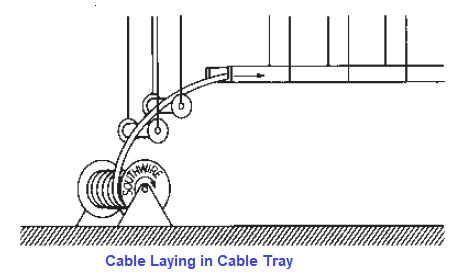
- Before laying of Cable , Cable Tray work should be completed form the one end to other end of the Cable route * The cable tray must be cleaned and …