
Difference between PVC- LSF-LSHF- FR- FRLS -FRLSH Cables. (PART-1)
DIFFERENCE BETWEEN PVC- LSF-LSHF- FR- FRLS -FRLSH CABLES. (PART-1)
INTRODUCTION:
- Due to lack of standardization and lack of awareness. While selecting of Cable, there is a lot of confusion and misunderstanding regarding the terminology associated with cables in terms of “LSF / LS” (Low Smoke), “LSZH / LSHF (Low Smoke Halogen Free),” FR” (Fire Retardant),”FR” (Fire Resistance) “FRLS” (fire resistant, low smoke), “FRLSZH” (Fire retardant Halogen-Free).
CABLE / WIRE TERMINOLOGY
- According to type of Insulation Material around the conductor, we can classify Cables / Wire in Three main Categories PVC, Zero Halogen and Fire Retardant. * According to application we can mainly classified in to Two categories
(A) Non-Fire Rated Cable
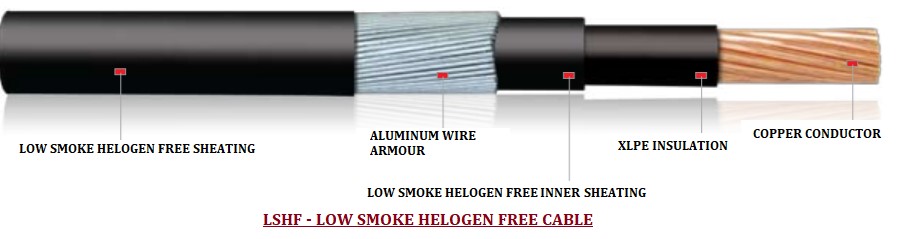
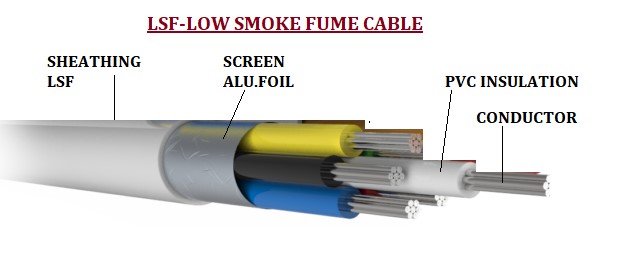
- PVC = Polyvinyl Chloride 2. LS / LSF = Low Smoke / Low Smoke Fume 3. LSHF / LSZH / LSNH = Low Smoke Halogen Free / Low Smoke Zero (No) Halogen 4. LH / HF = Low Halogen / Halogen Free
(B) Fire Rated Cable
- FR =Fire Retardant 6. FR =Fire Resistance 7. FRLS = Fire Resistant, Low Smoke 8. FRLSH= Fire Resistant, Low smoke, Low Halogen 9. FRLSZH / NHFR / ZHFR / HFFR = Fire Retardant Low Smoke Zero Halogen / Non (Zero) Halogen Free, Fire retardant 10. HRFR=Heat Resistance Fire Retardant
-
PVC, FRLS and FP cables, have conductors and insulation to manage the electrical current and voltage. Some also have extra physical protection, like steel wire armour. * PVC and FRLSH cables are different insulating materials around conductors for different application and performance.
-
The properties that distinguish one electrical insulation from the other are * (1) dielectric strength or break down voltage * (2) maximum permissible temperature * (3) dielectric loss * (4) permittivity; and some special properties to suit the application. * FRLS / FRLF is the quality of insulating material. It may be PVC or XLPE.
(A) NON-FIRE RATED CABLE
(1) PVC CABLE:
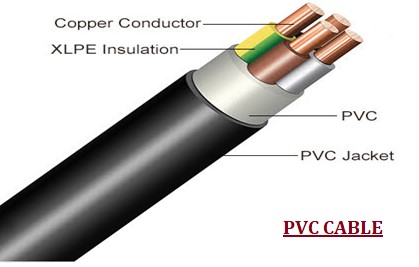
- PVC (Polyvinyl Chloride) cables is usually made up of a PVC compound as an insulating Material. * PVC insulation has a temperature limit of about 70°C. From the point of view of maximum permissible temperature, it belongs to the lowest class of insulation, yet it serves the purpose as the voltages and power ratings involved are relatively low. * While burring of PVC in case of Fire produces dense of black smoke and produce large amount of toxic gas and cocktail of harmful chemicals. * Smoke: * Burning PVC has been reduced visibility in the surrounding area by 50% within 10 minutes. After 30 minutes, visibility can be reduced by as 90% * This reduced visibility could make it very difficult to escape a burning Area / Building. * The smoke and fumes produced during a fire can be more dangerous to people than the fire itself. * Toxic Chemicals: * Burning PVC produces a number of toxic chemicals, but the most problematic is hydrogen chloride (HCI). PVC emits approximately 28% of Hydrogen Chloride (HCI). * In natural state HCL is a pungent, almost colorless gas, which forms into white vapor clouds on contact with air. * Furthermore, when mixed with water it changes state yet again to form Hydrochloric Acid, whether it’s in gaseous, vaporized or liquid state it’s a highly toxic and corrosive substance. * There are numerous harmful effects that HCl can have on a person. If inhaled the lining of the throat can be irritated to such an extent that it swells, making breathing extremely difficult. * Contact with the eyes can be responsible for anything from severe irritation to permanent damage to the corneas. Similarly, lips and mucous membranes may be burned or even ulcerated, the severity dependent on the concentration of HCl and length of exposure. * Taking into account the combined effects on someone of the smoke and HCl produced during the burning process, it’s difficult to see and the victims have been rendered unconscious long before the flames have reached them. * Some extent Fire Retardant property: * PVC is resistant to Fire ignition. * PVC (polyvinyl chloride) is naturally Fire Retardant due to chlorine base. It contains a large number of chlorine ions in the molecular structure and these are particularly difficult to break off when exposed to heat. * If it does catch fire, PVC has a particularly slow spread of flame. PVC has one of the lowest flames spread ratings, meaning that it won’t typically contribute to the spread of a fire * The temperature required to ignite rigid PVC is more than 150 deg C higher than that required to ignite wood. The ignition resistance of common flexible PVC formulations is lower, but with specialized formulations it may be significantly increased. * The fire in the gets extinguished immediately on removal of the fire source. * In the Plant or Building, PVC cables are bunched in the cable shaft or on cable trays. In case of fire in these cables the fire becomes self-sustaining. * Moreover, due to the…