
Difference between PVC- LSF-LSHF- FR- FRLS -FRLSH Cables. (PART-2)
DIFFERENCE BETWEEN PVC- LSF-LSHF- FR- FRLS -FRLSH CABLES. (PART-2)
(B) FIRE RATED CABLE (RETARDANT / RESISTANCE CABLE)
- Fire is one of the biggest risks in factories, public place and a majority of them occur due to electrical faults. * The terms Fire Resistant and Fire Retardant (both are commonly referred to as FR) terms are very similar and misused or confusing a lot. * Both are different in structure, in materials, in Application and react even differently in the event of a fire. If we required one but select other can lead the problem.
(1) FIRE RETARDANT CABLES
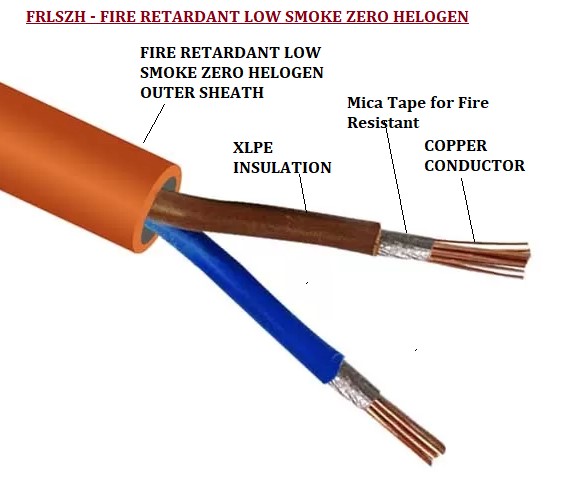
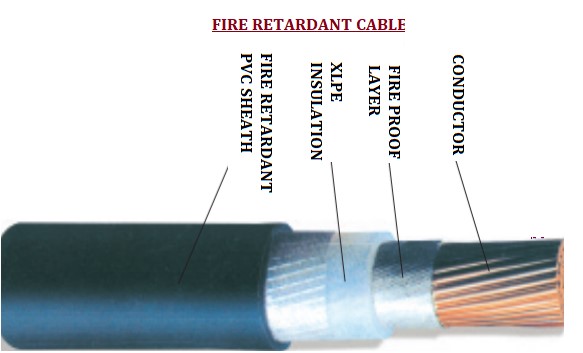
- Insulating Material of Fire Retardant Cable is chemically treated to Retard or Slowdown ignition or Burning of Fire hence slow down the spreading of fire. It also actually self-extinguishes when exposed to an open flame. * Flame-retardant Cable is characterized by delaying the spread of flame along the cable so that the fire does not expand. * Fire-resistant cables and flame-retardant cables are different in structure and materials. * The basic structure of the flame retardant cable is: * The insulation layer uses flame retardant. * The inner sheath and outer sheath are made of flame retardant. * The tape and filling use of flame retardant material.
11
Advantage:
- Low Cost compared to Fire Resistance Cable. * Produce Low Smoke
Disadvantage:
- By Adding Fire Retardant Material / Filler in PVC it decreases insulation property at least 10% compare to normal PVC, however its conductor temperature withstanding capability (during overload) remains only at 70 deg C same as ordinary PVC cables.
Applications:
- Control Wiring of Building * Fire Alarm Circuit
(2) FIRE RESISTANT CABLES
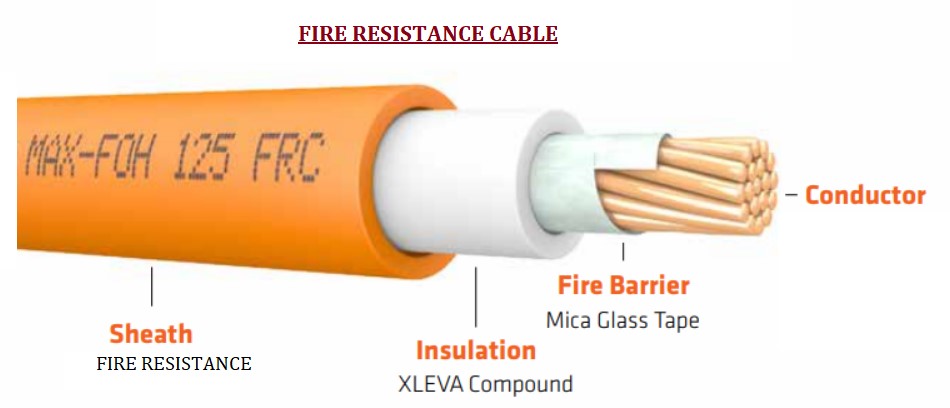
- The Fire resistance materials (non-flammable.) are designed to prevent / Resist the spread of fire (self-extinguishing) and will not melt or drip when in close proximity to a flame. * Because it self-extinguishes once the source of ignition is removed and does not melt or drip. Fire-resistant cables can maintain normal operation for a certain period under flame burning conditions and maintain the Circuit integrity and continue to work for a specified period of time under defined conditions hence improving the chances of escape and survival. * Because of Fire resistant fabrics are not usually made from 100% flame resistant materials, they will burn, but will do so very, very slowly and are often self-extinguishing. * A Fire-resistant cable is a cable that can maintain safe operation for a certain period under flame-burning conditions. Fire-resistant wires are widely used in high-rise buildings, subways, underground shopping malls, power stations, and important industrial and mining enterprises related to fire safety and fire rescue. For example, power supply wires and control wires for firefighting facilities. * Fire-resistant cable is divided into class A and class B. * Class B: Class B cable can be in 750 ℃ to 800 ℃ flame and rated voltage to withstand burning for at least 90min, and the cable is not broken. * In the refractory layer to improve the manufacturing process and increase the refractory layer and other methods based on * Class A: Class A fire rated cable can be 950 ℃ to 1 000 ℃ flame and rated voltage to withstand burning for at least 90min and the cable is not punctured. * Class A fire-resistant cable fire performance is better than class B. * Mineral Insulated Cable (MI): mineral insulated cable is a better performance of fire-resistant cables made of copper core, copper sheath, magnesium oxide insulation material processing, referred to as MI (mineral insulated cables) cable. * MI cable has good fire resistance characteristics and can work for a long time under 250 ℃ high temperature, but also explosion-proof, strong corrosion-resistance, high flow rate, radiation resistance, high mechanical strength, small size, lightweight, long life, and smokeless. However, the price is high. The process is complicated, the construction is difficult in the oil irrigation area, important public buildings, high-temperature places, and other fire-resistant requirements, and the economy can accept the occasion and use fire-resistant cable.
22
Advantage:
- Produce Low Smoke compared to Fire Retardant Cable.
Disadvantage:
- High Cost compared to Fire Resistance Cable. * By Adding Fire Retardant Material / Filler in PVC it decrease insulation property at least 10% compare to normal PVC, However its conductor temperature withstanding capability (during overload) remains only at 70 deg C same as ordinary PVC cables.
Applications:
- In Fire Fighting System, * In Fire Alarm Circuit
(3) FRLS (FIRE RETARDANT LOW SMOKE)
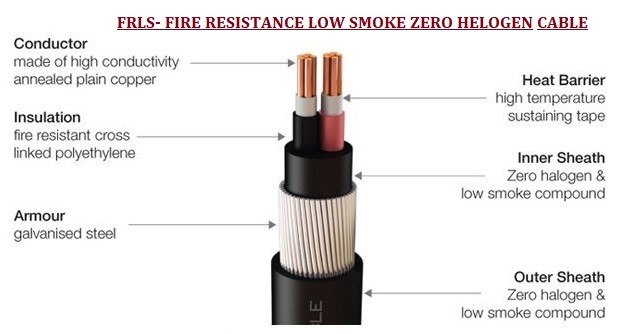
- To overcome these deficiencies of FR Cable, FRLS Cable was developed. * FRLS has special flame retardant, low smoke emitting and toxic fumes suppressing properties. * In FRLS Cable, inner sheath and/or outer sheath is made material …