
Which Class of Wire need to be used for House Wiring
WHICH CLASS OF WIRE NEED TO BE USED FOR HOUSE WIRING
November 9, 2025 Leave a comment
DIFFERENT CLASS OF CONDUCTOR
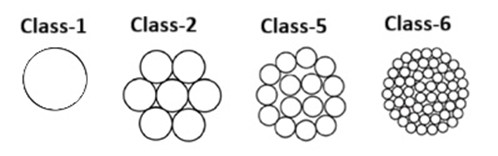
- As per IEC 60228, Electrical wires/cables are classified into different classes according to the conductor’s flexibility, conductor hardness & thermal effects. * There are four classes of flexibility for electrical cables * Class 1 = Solid conductor= ideal conductors for permanent installations. * Class 2 =Stranded conductor= conductors designed for fixed installation. * Class 5 =Flexible conductor= preferred to used where flexibility is required, for movable equipment , where there is vibration in equipment. * Class 6 =Very Flexible conductor= highly flexible conductors used in robotics, flexible codes. * Classes 3 and 4 are not described in IEC 60228. * The most basic type of conductor is a single, solid wire (Class 1). It provides a smaller diameter, the largest Cross-Sectional Area (CSA), and the clearest signal, it is mechanically fragile and susceptible to breakage after repeated bending cycles. * To improve flexibility, wires are stranded together (Class-2, Class-5, Class-6). Class 2 is a multi-wired conductor, while classes 5 and 6 are fine or ultra-fine wired conductors. The IEC standard specifies values such as the maximum diameter and maximum resistance for the individual wires. * The more wires that are stranded together to make a given size, the more flexible the conductor will be. This indicates that a higher class corresponds to a greater number of strands within the conductor. Additionally, stranded wires are significantly easier to manipulate and bend during installation compared to a single wire of equivalent cross-section. * Classes 1 and 2 are intended for use in cables for fixed installations. On the other hand, Classes 5 and 6 are designed for use in flexible cables and cords but may also be used for fixed installations.
(A) CLASS 1: SOLID CONDUCTORS
- Construction: Single Conductor, solid copper wire. * Flexibility: Rigid and non-flexible. the cable should not be bent more than about four times its diameter * Characteristics: High electrical conductivity and resistance to corrosion, but less suitable for environments requiring flexibility. * Advantages: Less expensive than cables with multiple wires * Disadvantages: Less suitable for applications involving movement. * Heat and Losses: Class 1 wires are more efficient for fixed wiring due to lower resistance and heat generation. * Applications: Typically used in permanent, stationary installations, House wiring where the conductor will not be subject to frequent movement or low flexibility is not a problem such as in building wiring and power distribution. * They are often used when cables with larger cross-sections are required for fixed installations. They are not suitable for very flexible cables, which are used, for example, in continuously moving objects such as robotic arms in industrial production
(B) CLASS 2: STRANDED CONDUCTORS
- Construction: Composed of multiple smaller copper wires twisted or braided together to form a single conductor. * Flexibility: More flexible than Class 1, allowing for some movement without breaking or damaging the wire. * Characteristics: Offers a balance of flexibility and durability but may not be as conductive as a solid conductor of the same gauge. * Advantages:Lower electrical resistance and less heat buildup under load. * Disadvantages:Less suitable for applications involving movement. * Heat and Losses:Class 2 wires are more efficient for fixed wiring due to lower resistance and heat generation. * Applications: Primarily used for fixed installations like permanent building and house wiring and for industrial applications with increased cable flexibility requirements.
(C) CLASS 5: FLEXIBLE CONDUCTORS
- Construction: Consists of many fine copper wires (often tinned for corrosion resistance) twisted together, making the conductor highly flexible. * Flexibility: Extremely flexible, designed for applications where the conductor needs to withstand frequent movement, bending, or vibration without damage. * Characteristics: High flexibility, durable against wear and tear, but may have slightly lower conductivity compared to solid conductors due to the finer strands. * Advantages:Superior flexibility. * Disadvantages:Higher electrical resistance, which can result in greater heat loss and voltage drops. * Heat and Losses:Class 5 wires are not efficient for fixed wiring due to higher resistance and heat generation compared to Class-2. * Applications: Used in situations where more flexibility is required, such as in circuits that may need to be bent, coiled, or moved occasionally. Ideal for portable appliances and equipment that move constantly like portable cords, flexible cables, and power tools that require a durable,…