

Impact of Floating Neutral in Power Distribution
IMPACT OF FLOATING NEUTRAL IN POWER DISTRIBUTION
INTRODUCTION:
- If The Neutral Conductor opens, Break or Loose at either its source side (Distribution Transformer, Generator or at Load side (Distribution Panel of Consumer), the distribution system’s neutral conductor will “float” or lose its reference ground Point. The floating neutral condition can cause voltages to float to a maximum of its Phase volts RMS relative to ground, subjecting to its unbalancing load Condition. * Floating Neutral conditions in the power network have different impact depending on the type of Supply, Type of installation and Load balancing in the Distribution. Broken Neutral or Loose Neutral would damage to the connected Load or Create hazardous Touch Voltage at equipment body. Here We are trying to understand the Floating Neutral Condition in T-T distribution System.
WHAT IS FLOATING NEUTRAL?
- If the Star Point of Unbalanced Load is not joined to the Star Point of its Power Source (Distribution Transformer or Generator) then Phase voltage do not remain same across each phase but its vary according to the Unbalanced of the load. * As the Potential of such an isolated Star Point or Neutral Point is always changing and not fixed so it’s called Floating Neutral.
NORMAL POWER CONDITION & FLOATING NEUTRAL CONDITION
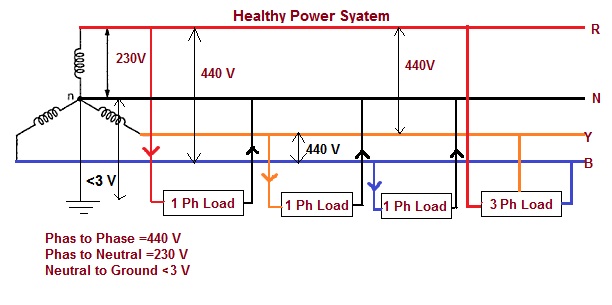
NORMAL POWER CONDITION:
-
On 3-phase systems there is a tendency for the star-point and Phases to want to ‘balance out’ based on the ratio of leakage on each Phase to Earth. The star-point will remain close to 0V depending on the distribution of the load and subsequent leakage (higher load on a phase usually means higher leakage). * Three phase systems may or may not have a neutral wire. A neutral wire allows the three phase system to use a higher voltage while still supporting lower voltage single phase appliances. In high voltage distribution situations it is common not to have a neutral wire as the loads can simply be connected between phases (phase-phase connection).
-
3 Phase 3 Wire System: * Three phases has properties that make it very desirable in electric power systems. Firstly the phase currents tend to cancel one another (summing to zero in the case of a linear balanced load). This makes it possible to eliminate the neutral conductor on some lines. Secondly power transfer into a linear balanced load is constant. * 3 Phase 4 Wire System for Mix Load: * Most domestic loads are single phase. Generally three phase power either does not enter domestic houses or it is split out at the main distribution board. * Kirchhoff’s Current Law states that the signed sum of the currents entering a node is zero. If the neutral point is the node, then, in a balanced system, one phase matches the other two phases, resulting in no current through neutral. Any imbalance of Load will result in a current flow on neutral, so that the sum of zero is maintained. * For instance, in a balanced system, current entering the neutral node from one Phase side is considered positive, and the current entering (actually leaving) the neutral node from the other side is considered negative. * This gets more complicated in three phase power, because now we have to consider phase angle, but the concept is exactly the same. If we are connected in Star connection with a neutral, then the neutral conductor will have zero current on it only if the three phases have the same current on each. If we do vector analysis on this, adding up sin(x), sin(x+120), and sin(x+240), we get zero. * The same thing happens when we are delta connected, without a neutral, but then the imbalance occurs out in the distribution system, beyond the service transformers, because the distribution system is generally a Star Connected. * The neutral should never be connected to a ground except at the point at the service where the neutral is initially grounded (At Distribution Transformer). This can set up the ground as a path for current to travel back to the service. Any break in the ground path would then expose a voltage potential. Grounding the neutral in a 3 phase system helps stabilize phase voltages. A non-grounded neutral is sometimes referred to as a “floating neutral” and has a few limited applications.
FLOATING NEUTRAL CONDITION:
- Power flows in and out of customers’ premises from the distribution network, entering via the Phase and leaving via the neutral. If there is a break in the neutral return path electricity may then travel by a different path. Power flow entering in one Phase returns through remaining two phases. Neutral Point is not at ground Level but it Float up to Line Voltage. This situation can be very dangerous and customers may suffer serious electric shocks if they touch something where electricity is present.