

Delta-Star Connection of Transformer
DELTA-STAR CONNECTION OF TRANSFORMER
(3) DELTA-STAR CONNECTION OF TRANSFORMER
-
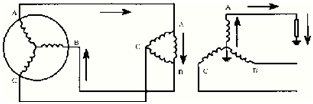
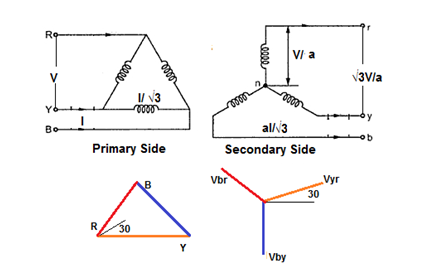
In this type of connection, the primary connected in delta fashion while the secondary current is connected in star.
-
The main use of this connection is to step up the voltage i.e. at the begining of high tension transmission system. It can be noted that there is a phase shift of 30° between primary line voltage and secondary line voltage as leading.
KEY POINT:
- As primary in delta connected: * Line voltage on primary side = Phase voltage on Primary side. * Now Transformation Ration (K) = Secondary Phase Voltage / Primary Phase Voltage * Secondary Phase Voltage = K X Primary Phase Voltage. * As Secondary in Star connected * Line voltage on Secondary side = √3 X Phase voltage on Secondary side. So, * Line voltage on Secondary side = √3 X K X Primary Phase Voltage. * Line voltage on Secondary side = √3 X K X Primary Line Voltage. * There is s +30 Degree or -30 Degree Phase Shift between Secondary Phase Voltage to Primary Phase Voltage
ADVANTAGES OF DELTA-STAR CONNECTION:
-
Cross section area of winding is less at Primary side: On primary side due to delta connection winding cross-section required is less. * Used at Three phase four wire System: On secondary side, neutral is available, due to which it can be used for 3-phase, 4 wire supply system. * No distortion of Secondary Voltage: No distortion due to third harmonic components. * Handled large unbalanced Load: Large unbalanced loads can be handled without any difficulty. * Grounding Isolation between Primary and Secondary: Assuming that the neutral of the Y-connected secondary circuit is grounded, a load connected phase-to-neutral or a phase-to-ground fault produces two equal and opposite currents in two phases in the primary circuit without any neutral ground current in the primary circuit. Therefore, in contrast with the Y-Y connection, phase-to-ground faults or current unbalance in the secondary circuit will not affect ground protective relaying applied to the primary circuit. This feature enables proper coordination of protective devices and is a very important design consideration. * The neutral of the Y grounded is sometimes referred to as a grounding bank, because it provides a local source of ground current at the secondary that is isolated from the primary circuit. * Harmonic Suppression: The magnetizing current must contain odd harmonics for the induced voltages to be sinusoidal and the third harmonic is the dominant harmonic component. In a three-phase system the third harmonic currents of all three phases are in phase with each other because they are zero-sequence currents. In the Y-Y connection, the only path for third harmonic current is through the neutral. In the ∆ -Y connection, however, the third harmonic currents, being equal in amplitude and in phase with each other, are able to circulate around the path formed by the ∆ connected winding. The same thing is true for the other zero-sequence harmonics. * Grounding Bank: It provides a local source of ground current at the secondary that is isolated from the primary circuit. For suppose an ungrounded generator supplies a simple radial system through ∆-Y transformer with grounded Neutral at secondary as shown Figure. The generator can supply a single-phase-to-neutral load through the -grounded Y transformer. * Let us refer to the low-voltage generator side of the transformer as the secondary and the high-voltage load side of the transformer as the primary. Note that each primary winding is magnetically coupled to a secondary winding The magnetically coupled windings are drawn in parallel to each other.
-
Through the second transformer law, the phase-to-ground load current in the primary circuit is reflected as a current in the A-C secondary winding. No other currents are required to flow in the A-C or B-C windings on the generator side of the transformer in order to balance ampere-turns. * Easy Relaying of Ground Protection: Protective relaying is MUCH easier on a delta-wye transformer because ground faults on the secondary side are isolated from the primary, making coordination much easier. If there is upstream relaying on a delta-wye transformer, any zero-sequence current can be assumed to be from a primary ground fault, allowing very sensitive ground fault protection. On a wye-wye, a low-side ground fault causes primary ground fault current, making coordination more difficult. Actually, ground fault protection is one of the primary advantages of delta-wye units.
DISADVANTAGES OF DELTA-STAR CONNECTION:
- In this type of connection, the secondary voltage is not in phase with the pr…