

Basic of External Lightning Protection System (LPS)-(Part-1)
BASIC OF EXTERNAL LIGHTNING PROTECTION SYSTEM (LPS)-(PART-1)
July 27, 2024 1 Comment
INTRODUCTION:
- A lightning protection system does not attract or prevent a lightning strike. but the lightning protection system provides a low impedance path to lightning currents to flow from Lightning striking Point to the ground to prevent dangerous flashovers and lightning-caused fires. * Lightning protection systems are designed to protect structures, equipment or people from the damaging effects of lightning strikes. These systems create pathways for lightning strikes to travel safely from the top of a structure to the ground with a lightning conductor. They protect the internal electrical components of a building by preventing fires or electrocution for that all metallic installations in the building must be made at equal potential. * The basic goal of LPS is to prevent thermal, mechanical, and electrical effects that can cause damage to the protected structure or to humans via touch or step voltages within the structure.
LIGHTING PROTECTION STANDARDS:
- There are various lighting protection standards. Widely use are * IEC 62305 * IS 2309 * NFPA 780 * NBC-2016
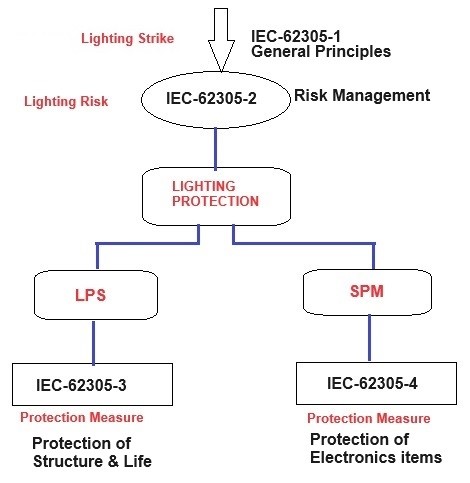
IEC:62305 -Part 1 to 5:
COMPARISON BETWEEN IEC AND IS STANDARD FOR LPS:
Comparison between IEC and IS standard for External LPS
Description LPS as per IEC 62305 LPS as per IS 2309 ESE (Early Streamer Emission) Coverage area Real, Calculated and approved design as per building type complying to IEC 62305-3. Real, Calculated and approved design as per building type complying to IEC 62305-3. Imaginary – no proof available, Not complying and national or international standard. Approvals / Applicability of latest standard IEC 62305-3 – International standard, Released in 2010 IS 2309 & IS 3043 – National standard, Released in 1989 Approved only in France which is their local standard Insurance cover Yes. Yes. No. Not approved by IS & CEA Height limitation No height limitation as the LPS is based on horizontal air terminal No height limitation as the LPS is based on horizontal air terminal Height restriction is applicable surrounding the airport area as ESE is based on Vertical air terminal. Air Termination Design Rolling sphere method Protective Angle method & Mesh method Not as per any international method. LPS for Type of Building Any type of complex building. Simple and Flat /Slopped Building Material for Air terminal & down conductor. 8mm Aluminum round, which is easier to install, bend & needs less conductor holder. 25X3 GI is used which is difficult to install, bend & needs twice the amount of conductor holder. Not as per any international method. Material compatibility Taken care using bi-metal connector No specific mention in the standard. Not taken care. Expansion /contraction of metal in summer/winter Taken care of using Expansion pieces. Not taken care Not applicable as it is based on vertical air terminal. No of Down Conductor. More than one down conductor to dissipate the Lightning current to the ground (Multiple Dissipation) Less number of down conductors when compared to IEC 62305 In most of the sites, only one down conductor is installed. Current sharing Path Many Parallel paths. LEMP has minimal effects Few parallel paths Maximum 2 Parallel paths. High LEMP can damage electronic equipment. Design of LPS based on LPL 1 to 4 backed up by IEC 62305 Based on Experience & old IEC, BS standards. Not as per any international method. Experience Used for many decades without any problem. Used for many decades without any problem. Approximately 15 years old. In Some country many buildings with ESE were damaged. Grounding Type B as per IEC 62305-1 Ring earthing as per IS 3043 Recommended only for small residences (not even apartments) where electronic equipment is not available. Installation time consuming but effective time consuming but effective less time consuming but ineffective
LIGHTING PROTECTION LEVELS:
- Lighting Protection Level are divided into four categories. For each category, a set of maximum and minimum lightning current parameters is fixed (LPL I to IV). * The maximum values of lightning current parameters are used to design lightning protection components (e.g. Cross section of conductors, thickness of metal sheets, current capability of SPDs and Separation distance against dangerous sparking). * The minimum values of lightning current amplitude for the different LPL are used to derive the Rolling Sphere Radius to define the Lightning Protection Zone (LPZ0B) which cannot be reached by direct strike.
RELATION BETWEEN LPL AND CLASS OF LPS
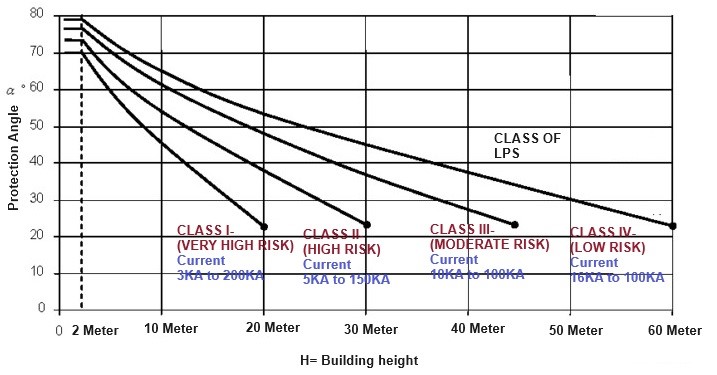
Table-7, IEC- 62305-3 LPL RISK LEVEL CLASS OF LPS CLASS I Very High Risk I CLASS II High Risk II CLASS III Moderate Risk III CLASS IV Low Risk IV
CLASSIFICATION OF LPS
Table-4,…