
Basic of External Lightning Protection System (LPS)-(Part-2)
BASIC OF EXTERNAL LIGHTNING PROTECTION SYSTEM (LPS)-(PART-2)
August 10, 2024 1 Comment
(B) ROLLING SPHERE METHOD: (SUITABLE FOR COMPLEX SHAPE BUILDING)
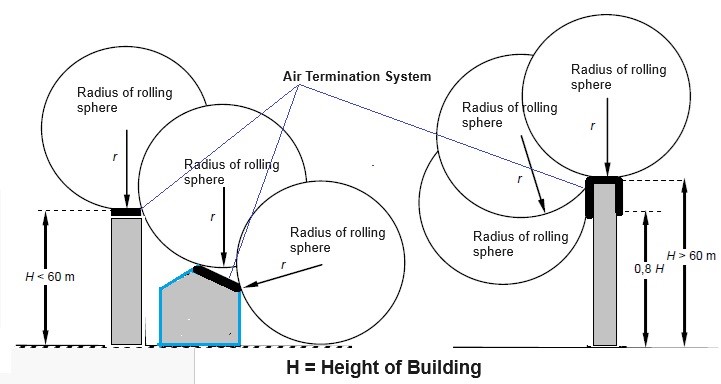
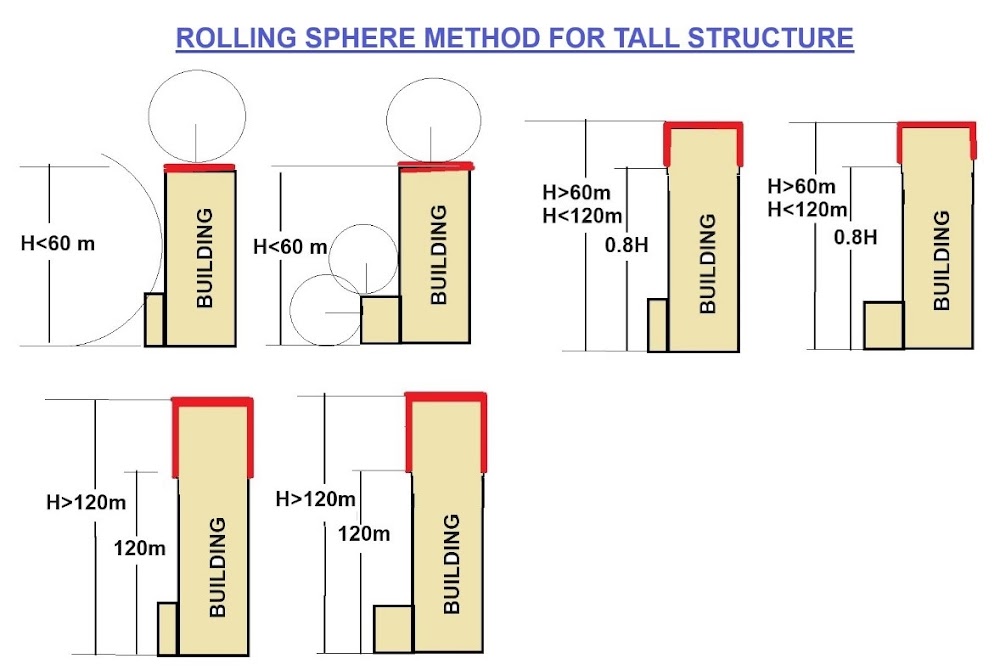
- The rolling sphere method should be used to protect the areas of a structure when there is design limitation to use the protection angle method. * The rolling sphere method is recommended as the main method to be used in the design of lightning protection system with location of air terminals for structures with complex shapes. * This method is more accurate, and complex compared to other lightning protection schemes, because it specifies the exact number of spikes needed for each building and considers the worst-case scenarios, in which a lightning strike hits the side of the building. * Position of Air Termination Rod: * In this method, the positioning of the Air-Termination system is adequate so that no point of the structure to be protected comes in to contact with a sphere with radius ‘r’ depending on the class of LPS (see table) rolling around on top of the structure in all possible directions. In this way, the sphere only touches the air termination system (see figure). * Radius of Sphere: * The rolling sphere lightning protection method assumes the electrically charged field that produces a lightning strike has a radius “r” and the sphere with that radius rolling over the surface of the building. Any place the sphere touches the building is a location where lightning can strike the building. By installing air terminals, the sphere cannot touch the building because electrical charges flow through the lightning protection system into the ground. * The radius of the rolling sphere is correlated with the peak value of the current in the lightning that strikes the structure: r = 10xIx0.65 where I define as kA. * In the rolling sphere method, the radius of the sphere is selected in such a way that its radius is equal to the striking distance. Since the striking distance is a function of the prospective return stroke current, the radius of the sphere “r” is defined as a function of the probable return stroke current according to the relationship between the lightning striking distance and the peak return stroke current. * The lightning stroke depends on the degree of risk considered. So, for a high-risk facility, the sphere radius is at its smallest, e.g. 20meter or a 40meter diameter ball. The smallest size ball means the amount of protection installed will be at its highest. Thus, lowering the risk profile and increasing the protection afforded. * For a low-risk scenario method, the sphere radius is at its largest distance, 60 meters (120-meter diameter ball), which means a lot less hardware to install. * The radius r of the rolling sphere depends on the class of LPS as per given Table.
RADIUS OF THE ROLLING SPHERE
Class of LPS Rolling sphere radius, r (m) CLASS I- (Very High Risk) 20 Meter CLASS II- (High Risk) 30 Meter CLASS III- (Moderate Risk) 45 Meter CLASS IV- (Low Risk) 60 Meter
-
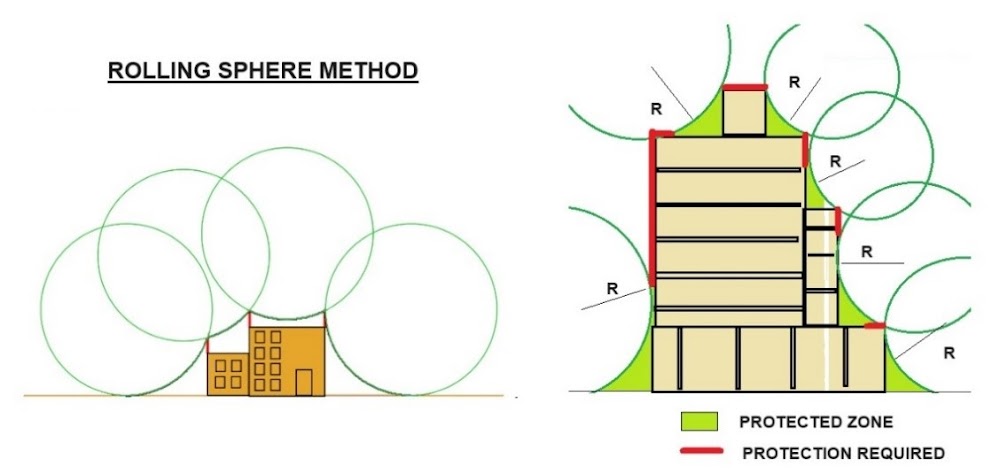
Figure shows the application of the rolling sphere method to different types of structures. The sphere of radius r is rolled around and over all the structure until it meets the ground plane or any permanent structure or object in contact with the ground plane which can act as a conductor of lightning. * A striking point could occur where the rolling sphere touches the structure and at such points protection by an air-termination conductor is required. * Any part of the structure that is in contact with the sphere is considered to be vulnerable to a direct lightning strike; the untouched volume defines a lightning protected zone.
-
When the rolling sphere method is applied to the structure, the structure should be considered from all directions to ensure that no part protrudes into an unprotected zone a point which might be overlooked if only front, side and plan views on drawings are considered.
PENETRATION DISTANCE:
-
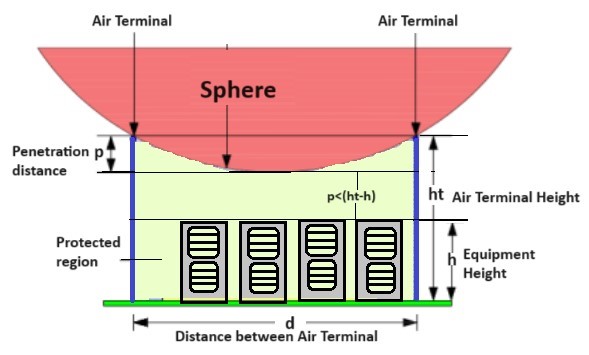
The distance between the two air terminals should be chosen in such a way that protection is provided for all the objects placed on the surface to be protected. * The protection of the objects placed on the surface can be ensured by calculating the penetration distance of the rolling sphere. * The distance between the level of air terminals and the least point of sphere in the space between the air terminals is called penetration distance.
-
Let us consider an object of height ‘h’ placed on the surface to be protected. Let ‘ht’ be the height of the air terminal, ‘p’ be the penetration distance and ‘d’ be the…