

Star-Star Connection of Transformer
STAR-STAR CONNECTION OF TRANSFORMER
Transformer Connection:
The windings of three phase transformers may be connected in by Y or Δ in the same manner as for three single phase transformers. Since the secondary’s may be connected either in Y or Δ regardless of which connection is used on the primaries, there must be four ways of connecting the windings of a 3-phase transformer for transformation of 3-phase voltages, namely Y-y,Δ -Δ, Y-Δ, and Δ -y. The inter-connections are made inside of the case so that only the terminal leads need to be brought outside the case
- Star – Star Transformer (Yy0 or Yy6) 2. Delta – Delta Transformer (Dd0 or Dd6) 3. Delta – Star Transformer (Dy) 4. Star – Delta Transformer Yd) (Grounding Transformer). 5. Zig-zag Transformer (Yz, Dz) (Grounding Transformer) 6. Scott (“T” Type) Transformer (Grounding Transformer).
(1) STAR-STAR(Y-Y)CONNECTION:
-
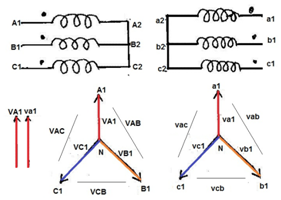
In Primary Winding Each Phase is120°electrical degrees out of phase with the other two phases. * In Secondary Winding Each Phase is120°electrical degrees out of phase with the other two phases. * Each primary winding is magnetically linked to one secondary winding through a common core leg. Sets of windings that are magnetically linked are drawn parallel to each other in the vector diagram. In the Y-Y connection, each primary and secondary winding is connected to a neutral point. * The neutral point may or may not be brought out to an external physical connection and the neutral may or may not be grounded.
-
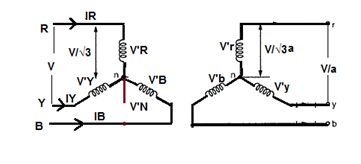
Transformer magnetizing currents are not purely sinusoidal, even if the exciting voltages are sinusoidal. The magnetizing currents have significant quantities of odd-harmonic components. If three identical transformers are connected to each phase and are excited by 60 Hz voltages of equal magnitude, the 60 Hz fundamental components of the exciting currents cancel out each other at the neutral. This is because the 60 Hz fundamental currents of A, B, and C phase are 120° out of phase with one another and the vector sum of these currents is zero. * The third, ninth, fifteenth and other so-called zero-sequence harmonic currents are in phase with each other; therefore, these components do not cancel out each other at the neutral but add in phase with one another to produce a zero-sequence neutral current, provided there is a path for the neutral current to flow. * Due to the nonlinear shape of the B-H curve, odd-harmonic magnetizing currents are required to support sinusoidal induced voltages. If some of the magnetizing current harmonics are not present, then the induced voltages cannot be sinusoidal. * Y-Y Connection with Grounded Neutral : * Figure Show the situation where the primary neutral is returned to the voltage source in a four-wire three-phase circuit. Each of the magnetizing currents labeled IR, IY, and IB contain the 60 Hz fundamental current and all of the odd harmonic currents necessary to support sinusoidal induced voltages.
-
The zero-sequence magnetizing currents combine to form the neutral current IN, which returns these odd harmonics to the voltage source. Assuming that the primary voltage is sinusoidal, the induced voltages VR , VY , and VB (in both the primary and secondary) are sinusoidal as well. * The connection of primary neutral to the neutral of generator has an add advantage that it eliminates distortion in the secondary phase voltages. If the flux in the core has sinusoidal waveform then it will give sinusoidal waveform for the voltage. But due to characteristic of iron, a sinusoidal waveform of flux requires a third harmonic component in the exciting current. As the frequency of this component is thrice the frequency of circuit at any given constant. It will try to flow either towards or away from the neutral point in the transformer windings. With isolated neutral, the triple frequency current cannot flow so the flux in the core will not be a sine wave and the voltages are distorted. If primary neutral is connected to generator neutral the triple frequency currents get the path to solve the difficulty. The alternative way of overcoming with this difficulty is the use of tertiary winding of low KVA rating. These windings are connected in delta and provide a circuit in which triple frequency currents can flow. Thus sinusoidal voltage on primary will give sinusoidal voltage on secondary side. * This situation changes if the neutrals of both sets of the primary and secondary windings are not grounded. * Y-Y Connection without Grounded Neutral: If the neutrals of both the primary and the secondary are open-circuited and so there is no path for the zero-sequence harmonic currents to flow and …