

Selection of Surge Protective Device (SPD)- (Part 3)
SELECTION OF SURGE PROTECTIVE DEVICE (SPD)- (PART 3)
TYPE OF SPD:
TYPE 1 SPD:
-
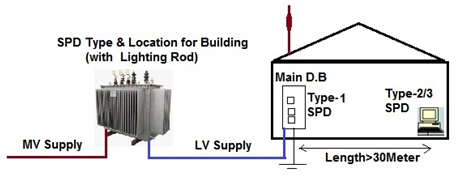
Protection for : Transient Over voltages due to Direct Lightning Strokes * Location : It is installed at any location between the secondary of the utility service transformer and the service entrance primary disconnection
-
It is installed in the main electrical switchboard when the building is equipped with a lightning protection system. * It protects against external surges caused by lightning or utility capacitor bank switching. * These devices to discharging a very high lightning current from earth to the power distribution system. * Current ratings: 10Ka to 35Ka – 10/350µs wave form.
-
Required Dedicated Fuse / Circuit Breaker for SPD : No * Risk Factor : Very strong risk Area
TYPE 2 SPD:
-
Protection for : Transient Over voltages due to Switching and Indirect Lightning Stroke. * Location: It is installed in the main distribution switchboard.
-
It is designed to discharge the currents generated by indirect lightning strokes and causing induced or conducted overvoltage on the power distribution network. * It protects against residual lightning energy, motor driven surges and other internally generated surges.
-
Current ratings: 5Ka to 200 Ka – 8/20µs wave form. * Required Dedicated Fuse / Circuit Breaker for SPD : May or May Not
-
Risk Factor : Common risk Area
TYPE 3 SPD:
- Protection for: Sensitive Loads. * It is installed as a supplement to Type 2 devices and to reduce the overvoltage at the terminals of sensitive equipment. * Their current discharge capacity is very limited. As a consequence they cannot be used alone. * Installed at minimum conductor length of 10 meters (30 feet) from the electrical service panel to the point of utilization * Provides point-of-use protection, easily replaceable and it provides the last line of defense against a lightning strike. * Risk Factor : Very strong & common risk Area
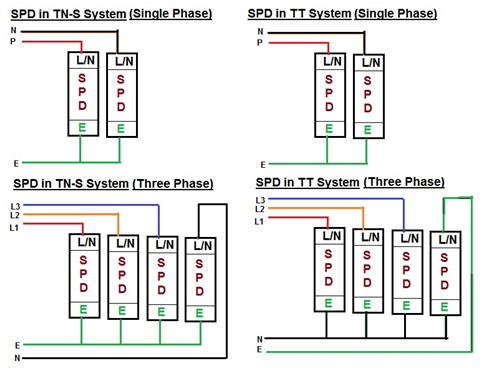
CONNECTION OF SPD IN DISTRIBUTION BOX.
- In common mode: Phase to earth or neutral to earth * In differential mode: Phase to phase or phase to neutral
0
FACTORS EFFECT ON SPD PERFORMANCE:
(1) LOCATION OF SURGE PROTECTION DEVICE:
- Lightning protection should be installed on a overall viewpoint of Protection. * For large industrial plants, data centers, hospitals, a risk assessment method must be used to guide in choosing optimal distance. * In other cases like housing, offices, buildings Where there is not or less sensitive industrial risks, we may adopt following principle to select SPD.Type 2 surge protective device should be installed in the electrical installation’s incoming Main switchboard. * If the distance between that surge protective device and the equipment to be protected is more than 30 meters, than additional surge protective device (Type 2 or Type 3) should be installed near the equipment.
1
-
When the building is equipped with a lightning protection system, a Type 1 surge protective device must be installed at the incoming Main Switch Board. There exist surge protective devices combining Type 1 and Type 2 in the same enclosure. 2
-
The Lightning rods have to be located on the highest points of the structure, taking into account the location of the grounding, and that the path of the down conductors are as short and straight as possible .
(2) SIZE OF DOWN CONDUCTOR:
- Lightning is a phenomenon that generates a high frequency voltage. The length of the cables must be taken into account in cases of high frequency. * The down conductors may be tapes, stranded wire or solid round. * The minimum cross section must be * 1 meter of cable crossed by a lightning current generates an overvoltage of 1,000V. * Mandatory in Standard IEC 60364-5-534: * L (length of cables) < 50cm, * Cable cross-section of Cable (S) < 16mm² (Type 1). * Cable cross-section of Cable (S) < 4mm²(Type 2).
(3) PLACEMENT OF DOWN CONDUCTOR
- Down conductor will be placed on the outside of the structure. * When it is impossible to make a down conductor on the outside, conductors can be introduced in a non-flammable insulating pipe, with a minimum section of 2000 mm2, for this purpose. * The down conductors on the inside decrease the effectiveness of lightning protection, increase the risk of over voltages penetration of and difficult the verification and maintenance of installation.
(4) NUMBER OF DOWN CONDUCTOR
- At least one down conductor for every lightning rod. A minimum of two down conductor when, * (1) The horizontal Projection length of the conductor exceeds its vertical projection length. * (2) The height of the structure is greater than 28 meter. * Equi potential bonding will be mad…