
Selection of Various Types of UPS (Part-1)
SELECTION OF VARIOUS TYPES OF UPS (PART-1)
INTRODUCTION:
- Whenever there is a power cut, electricity supply to Computer, Desktop or other critical appliances is cut off and they stop working. However, if we have a backup supply device such as UPS, we can ensure uninterrupted supply of power to appliances to be not bothered with power cuts. * Electrical power supply comes from utility companies is not pure it has different Electrical abnormalities like surges, under voltage, Over Voltage, Voltage dips, voltage spikes, Noise and harmonics. These Electrical abnormalities can cause serious damage to Electronics equipments, Data Systems, Computer or Desktop. * To decrease the risk of power supply distortion, UPS systems are frequently integrated in electrical networks. Electronic power supply equipment makers can offer consistent, high-quality power flow for various Electrical / Electronic load gear likes continuous industrial processing applications, medical services, emergency gear, telecommunications, & computerized data systems. * Today’s UPS systems usually provide some level of power conditioning and protection against fluctuations in voltage from the grid.
UPS:
- UPS means uninterrupted power supply. * Uninterruptible power supply (UPS) provides uninterrupted power to the equipment. It means switching time from power cut to battery power is very less hence important equipment like computer, desktop is not switch off and we can lose data. * A UPS is a complete system that is consisting of many parts that include batteries, a charge controller, circuitry any transfer switch for switching between the mains and back-up battery, and an inverter. An inverter is needed because the battery can only store DC power and we need to convert that back to AC in order to match the appliances connected in the main power line. * UPS= Battery charger + Inverter * UPS is nothing but inverter with inbuilt battery charger. * UPS is used only to backup your system. If we connect desktop computer on inverter. Inverter takes some seconds to give battery power to equipment hence equipment shutdowns for some second in any power loss condition and we can lose important data of desktop or computer. * Inverter is not suitable for computer backup due to the delay in switching. * One of more useful functions of UPS is to provide surge protection so connected devices can be protected from line Surge and does not damage. UPS is also capable of conditioning the power from the lines to provide clean and stable power throughout.
BLOCK DIAGRAM OF UPS:
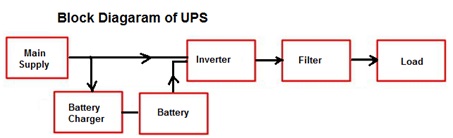
- The block diagram of this UPS is shown as below
1
- The mains power comes to the UPS. The AC is converted to DC and this DC is constantly charging the battery. The output of the battery is fed to the Sine wave inverter and it converts DC to AC and this feeds the equipment. Since power out is always drawn from the battery, there is no time lag when mains switches off, it just stops the battery from being charged and the UPS continues to supply power till the battery runs out. * Battery Charger (Rectifier ): To convert AC Power (from Power Grid) to DC Power to charge Battery * Battery: To provide DC Power. * Inverter: To convert DC Power (from Battery) to AC Power (to power load i.e., electrical and electronic equipment.) * Controller: To control functions of Rectifier (Charger) and Inverter. (i.e., when to start or stop charging battery, when to start or stop power from battery to load, how fast to change from Grid Power to Battery Power and so on)
TYPE OF UPS:
- The UPS is mainly categorized into three types according to their functions. They are as
- Offline Standby (where system or data loss is an inconvenience) 2. Line-interactive (system or data loss is a serious problem). 3. Online/Double Conversion (system or data loss is unacceptable).
(1) OFF LINE UPS / STANDBY UPS:
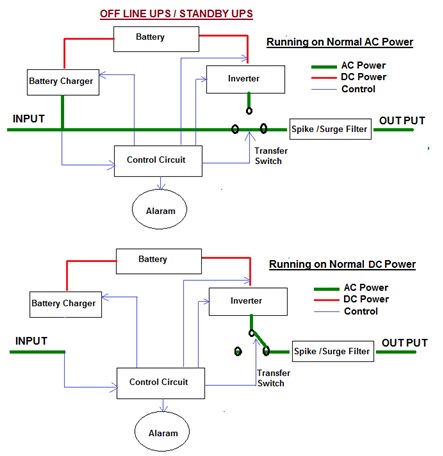
- Off-line UPS systems are so-called “OFF Line” because load is normally connected directly to the incoming AC mains. When the incoming AC mains fails or fall below a pre-determined level, then the offline UPS turns on its internal DC-AC inverter circuitry, which is powered from an internal storage battery. * For switching purpose UPS consists mechanically / Static switches which immediately connect the load on its DC-AC inverter output under the mains power failure condition. During this changeover there is an inevitable break in power to the load of typically 2 to 10 milliseconds. In practice, however, most loads can ride through this period without any problems. * The switching process causes a momentary lapse in power which is dangerous for certain highly-sensitive equipment. This is why technically, the standby UPS is not considered a “true UPS”, as it is not truly “uninterruptible”. * The typical lapse time 5ms,is well within tolerance for normal desktop computers
Circuit Diagram:
1
Working…