
Selection of Various Types of UPS (Part-2)
SELECTION OF VARIOUS TYPES OF UPS (PART-2)
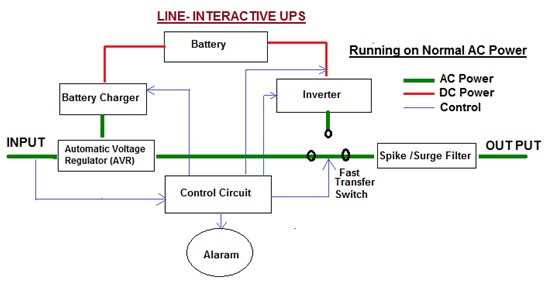
(2) LINE-INTER ACTIVE UPS:
- Working Principle of Line Interactive UPS is same as OFF Line/ stand UPS. It connected directly from mains, switching to battery (via the inverter) in mains Power cut condition. * The designing of line interactive UPS is same as OFF Line UPS in addition the design Line Interactive generally includes an automatic voltage regulator (AVR) or a tap-changing transformer. This enhances the regulation of voltage by regulating transformer taps as the input voltage differs. * The main difference between an off-line and a line-interactive UPS is that a line-interactive UPS in the stand-by mode has active voltage regulation. * Voltage regulation is a significant feature when the conditions of a low voltage exist, otherwise the UPS would transfer to battery and then finally to the load. The usage of more common battery can cause early battery failure. * It typically uses either a Ferro resonant transformer or a buck-boost transformer. Both helps to reduce the frequency of transfers to battery, slightly improving efficiency and reducing battery wear. * Ferro resonant designs also offer power conditioning and tight voltage regulation, as well as an energy store that can maintain uninterrupted power supply output while the inverter switches on.
Circuit Diagram:
1
Working Function:
- Normal Condition: * In Normal Power Condition, power supply will continuously provide to Load with some filtering and voltage regulation circuit. * During normal operation, the Line Interactive UPS takes utility power and passes it through a transformer with various tap selections on the output. When utility power is high, the Line Interactive UPS selects a tap to lower (buck) the output voltage. Similarly, when the utility voltage is low, the UPS selects a tap to increase (boost) the output voltage. * In Normal Condition Battery is charged continuous charge through Battery Charger * Battery charger convert AC power to DC Power and this DC Power charged Battery. * Power outage Condition: * When utility power fails, the device will start its internal inverter Circuit by Mechanical Switch. * Mechanically transfer Switch Transfer from utility power to Battery Power, inverter output. * This transfer can take as 2 to 4 ms.
Advantage:
- small Size * Low cost * High Efficiency (because less power conversion is when AC input is present). * Sine Way Output. * Battery life is good compared to OFF Line UPS. * Voltage regulation is fair (more than OFF Line UPS but Less than ON Line UPS) * EMI/RFI/Noise Rejection is good. * Change over Time is 2 to 4 Milliseconds. * Lower electricity consumption (less costly to operate). * Higher reliability (Lower component count and lower operating temperatures).
Disadvantage:
- No isolation between main supply and load * Higher Heat Output * More Expensive * Problematic with power factor corrected loads.
Applications:
- For small business. * IT Racks, Network Switches, Medical Instrument System where data loss is a serious problem. * The line interactive UPS may not be the appropriate choice for installations where AC power is unstable or highly distorted, because battery power will be used too often to keep the UPS output within specifications.
Capacity:
- UPS in the range of 500VA to 5kVA power.
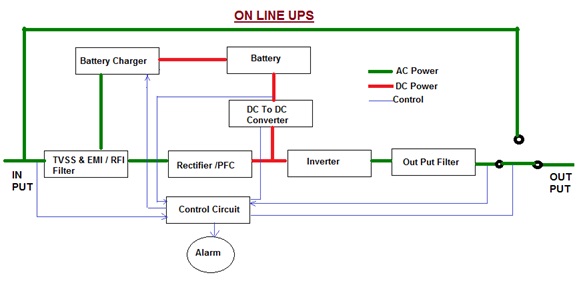
(3) ON LINE UPS/ DOUBLE CONVERSION UPS
- It is truly uninterrupted power system (UPS) provide continuous power to load in any condition. * Online UPS sometimes called “double conversion” UPS. * Today most users with highly-critical loads are choose online UPS .It is used to protect sensitive equipment and data from mains problems at all times with any extra cost. * This UPS have no power transfer switches and therefore no transfer time is existed under the mains power failure. Thus this is truly an uninterrupted system. * In Online UPS to maintain the charge of the battery, a battery charging unit is continuously powered from the AC mains. * Online UPSs are often called ‘double conversion’ types because incoming power is Firstly converted once AC to DC for the battery and then back Secondly Converter DC to AC before reaching the load which is therefore well-insulated from the mains like an electrical firewall between the incoming power and sensitive electronic equipments. It also control of the output voltage and frequency regardless of the input voltage and frequency. * The online UPS continuously filters power through the battery before sending it to your computer. * By contrast, online UPS systems draw power through the power conditioning and charging components during normal operation, so the load always receives conditioned power rather than raw mains.
Circuit Diagram:
1
Working Function:
- The designing of this UPS is similar to the Standby UPS, excluding that the primary power source is the inverter instead of the AC …