




CO Detection & Control Systems for Basement Car Parking
CO DETECTION & CONTROL SYSTEMS FOR BASEMENT CAR PARKING
(1) INTRODUCTION
- Carbon Monoxide (CO), one of the most toxic components of vehicle exhaust and it is a significant safety concerns in Basement Parking area. When concentrations of CO approach unsafe levels, the ventilation system must be activated to normalize Co level of the Parking area.
(2) WHAT IS CARBON MONOXIDE
- Carbon monoxide gas has a simple molecule one part carbon and one part oxygen. * Carbon monoxides produce due to incompletion combustion (Fails to burn due to not enough Oxygen) of carbon containing compounds like wood, gasoline, coal, propane, natural gas, and heating oil. * CO produce when there is not enough oxygen to produce carbon dioxide (CO2) such as when operating a combustion engine in an enclosed space. * These carbon-containing compounds aren’t dangerous when it burns them in an open area with plenty of ventilation. But carbon monoxide is hazardous in confined spaces like basements, kitchens, garages, or campers. * Carbon monoxide is hard to detect without a sensor, which is one of the reasons it’s so dangerous. * Carbon Monoxide (CO) is dangerous for human beings and will cause even death within minutes. This is mainly formed in underground parking, basements etc. * The level of CO concentration is measured in parts per million (ppm). For example, 100 ppm CO
(3) EFFECTS OF CARBON MONOXIDE
- Carbon monoxide (CO) is a colorless, odorless and tasteless gas that is highly toxic for humans and animals; it bonds with hemoglobin and reduces the oxygen-carrying capacity of blood in the body.
(4) HOW CARBON MONOXIDE IS GENERATED IN BASEMENT:
- In a basement of a building, oxygen levels may not be sufficient, and the combustion may not be complete. This can occur in vehicles exhaust, gas stoves, boilers, coal heaters etc. which are operated in the basements. Under such conditions, Carbon Monoxide is generated. The occupants of the area will be unaware of the same and hence it becomes a dangerous environment. Hence continuous Carbon Monoxide (CO) monitoring is important for such area.
(5) COMPONENTS OF CO MONITORING SYSTEM FOR CAR PARKING
- The following components are essentially form a CO detection & CO monitoring system for a basement car parking. * CO sensors
B
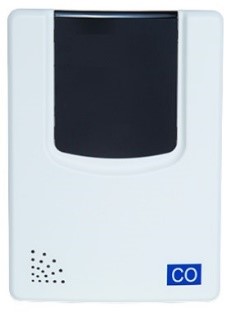
- A CO sensor is used to detect the level of CO and give an output signal. The number of required sensors is decided based on the size of the area or car park. * All sensors will be wired to the common PLC panel. * Location of CO Sensor: * The distance between the Co sensor and the source of CO is important. The air polluted with hazardous gases have to be in physical contact with the gas sensors. Because carbon monoxide is slightly lighter than air and it may be found with warm rising air Hence, CO Sensor is fitted at a distance of 3 feet to 5 feet from the ground surface
B1
- Do not place the detector right next to or over a fireplace or flame-producing appliance * Each CO sensor can cover approximately 5,000 to 10,000 sq ft of open space. CO gas will disperse and flow with natural air current and car movement. * Using the average of 7,500 sq ft per sensor and a circular radius of 49 feet, the sensors area coverage could be scaled and placed on the Basement layout to cover the open floor area. Based on the number of CO sensors and the location of the exhaust fans and make-up air handlers. * The most practical mounting location for a CO sensor within a basement area is the side of the support column away from traffic. * CO sensors will be more effective if placed in areas where CO levels are likely to be high. For example, do not place sensors adjacent to the fresh air intake. * Programmable Logic Controller (PLC) panel * All the inputs from the CO sensors are connected to a PLC (Programmable Logic Controller) for proper control functioning. The PLC will provide output signals to the VFD based on the inputs from the sensors. * Variable Frequency Drive (VFD)
B2
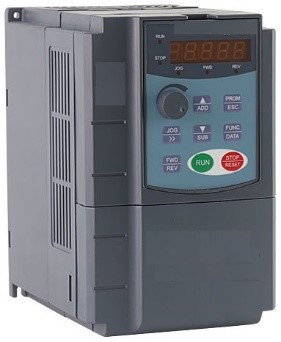
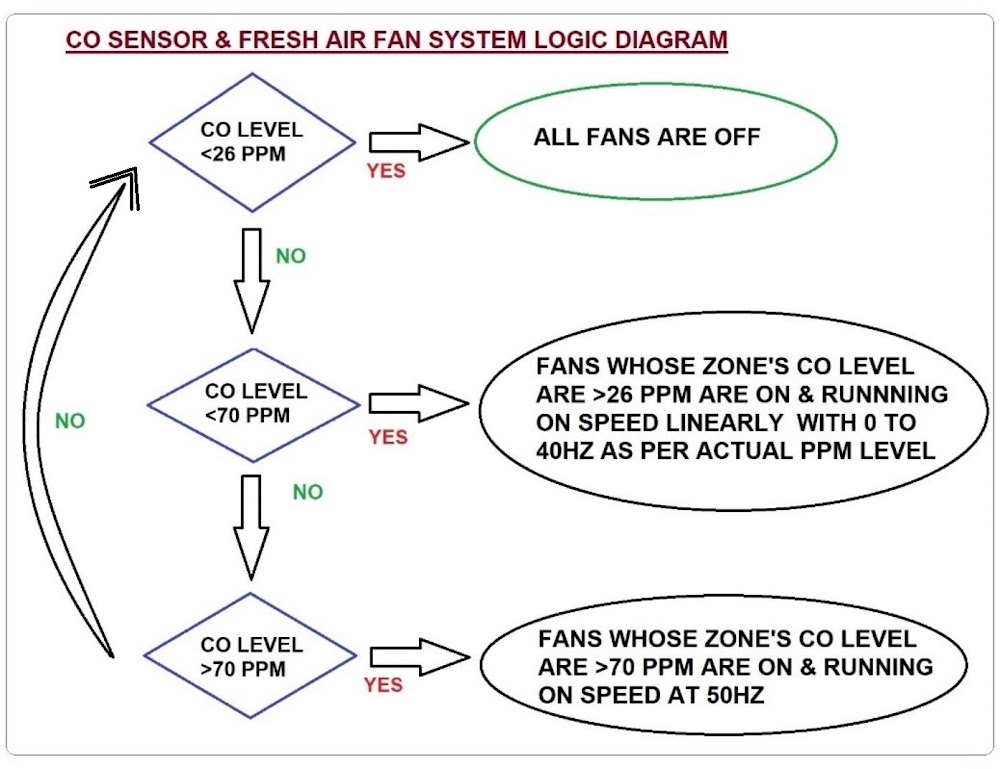
- A VFD is used to operate a motor at different speeds. This VFD will be controlled by the PLC and will control the exhaust fans. If the CO content is more, the exhaust fan operates at a faster speed. * Exhaust Fans / Fresh Air Fans
B3
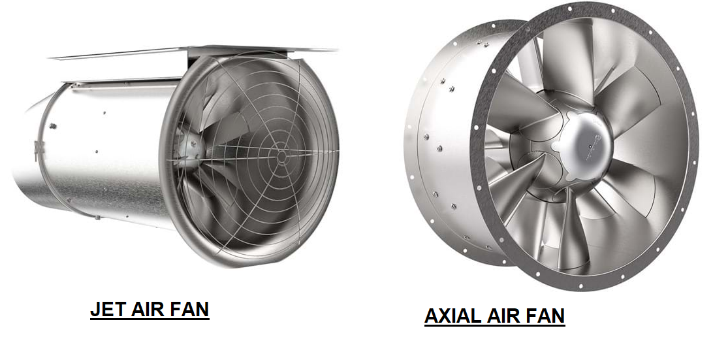
- The number of required Exhaust / Fresh Air fans will be decided based on the size and shape of the area. The Exhaust Fresh Air Fans are controlled by the VFD. Basically, the Exhaust Fans / Fresh Air Fan have to remove the contaminated air at a fast rate.
(6) WORKING PRINCIPLE AND SYSTEM ARCHITECTURE:
- A number of CO monitoring sensors are installed at various points of the basement car parking. The number of required sensors is decided based on the size of the area or car parking. * All CO sensors are wired to the common PLC panel to VFD to Exhaust Fan operations. * CO sensors detect various types of smoke, Smoke radicals, and fumes and generates a contr…