


Method for Installation of HVAC System (Part-1)
METHOD FOR INSTALLATION OF HVAC SYSTEM (PART-1)
PURPOSE:
- This method explains the Procedures or sequence of activity for safely and efficiently installation and Testing of Refrigerant Pipes , Drain Pipes ,Indoor and Out Door Unit of HVAC System as per standard Practice and Code.
GENERAL EQUIPMENT & TOOLS:
- The equipment that will be engaged for Installation of Cable works will be * Lifting crane , Transportation vehicle, Fork Lift * Winches, Pulling Rope , Welding machine * Lubricant (Soap based, wax based), Cleaning agent (CRP) * Copper pipe Flaring tools * Vacuum Pump, * Brazing Torch , Brazing Rod , Oxy-Acetylene Brazing Kit ,Wire Brush * Nitrogen Cylinders , Soldering Tools * Crimping tool, Drilling Machine with various Bits , Grinding Machine , Cutting Machine * Electrical Tool Box, Cable Cutter, Screwdriver, Pliers, Spanner. * Ladder , Scaffolding / Mobile scaffold * Nylon rope, Marker , Leveling device , Tape measure * Removable Barricades , Portable Lights * Testing Equipment for System * Multi meter ,Clamp Meter * Refrigerant / Nitrogen cylinder, * Vacuum Gauge
STORAGE & MATERIAL HANDLING:
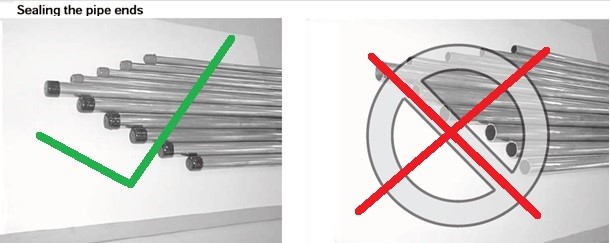
- The storage area must be free from dust and Water leakages / seepages. * Manufacturer recommendation shall always be followed in loading/unloading and storing of Material. * Material and its accessories shall be unloaded handle with care in designated area of the Store (Do not directly drop to Ground) to avoid any damages. * Materials shall be stored in a dry place which is free from water or from weather effects and protection should be given to the material by means of covering the material with Tarpaulin sheet. * The Material will be stacked / unload in the site store on a proper stand on wooden loft on a flat surface at a sufficient height from Ground. * The A/C Units should be kept on the wooden platform and covering with polythene to protected from any dust or mechanical damages * For storing the copper pipes: * If pipes will be used soon, nozzle should be sealed by plastic bag or tape. * If pipes will be stored for a long time, the pipes should be charged into 0.2 to 0.5MPa Nitrogen and the nozzle should be sealed by welding.
INSPECTION OF MATERIALS:
- Check The Material according to its Type, Size, Make * Physical Damages Inspection: * Damage on Pipes and Units. * Damage on insulation of Cable * In case of any damages observed during inspection, the Material shall be returned to the supplier for replacement.
INSTALLATION OF OUTDOOR UNITS :
(A) TRANSPORTING / LIFTING THE OUTDOOR UNIT
-
Use appropriate moving equipment to transport outdoor Unit, ensure the equipment is capable of supporting the weights. When lifting the unit, use lifting straps and place around the unit. * Always lift the unit using appropriate size of lifting straps rated to carry the unit weight and long enough to maintain a maximum of a 40° angle as shown. * When moving / adjusting the placement of the outdoor unit, always hold the unit by the corners. Moving the outdoor unit using the side intake holes on the frame may damage the frame. * Consider the unit’s center of gravity before lifting. Hoist the unit with the center of gravity centered among the lifting straps. There is a risk of the product falling and causing physical injury. * Lift the outdoor unit from the base at specified locations. Support the outdoor unit at a minimum of six points to avoid slippage from the rigging apparatus. * Do not lay the unit on its side and do not slant the unit more than 30 degrees.
-
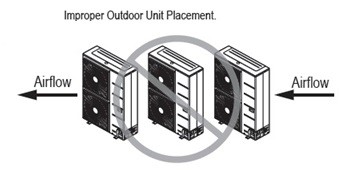
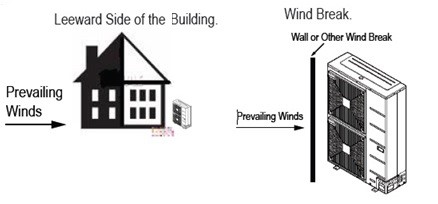
On a supporting structure that can bear the weight of the outdoor unit. The supporting structure can be a base on the ground, on a waterproof roof, or in a pit. With sufficient clearances around the unit for service and repairs. In a well-ventilated location. Away from strong wind. * Away from direct exposure to rain or snow. Where there is no risk of flammable vapor leakage. Where there is no exposure to salt, machine oil, sulfide gas, or corrosive environmental conditions.
(B) SELECTING THE BEST LOCATION FOR THE OUTDOOR UNIT(S)
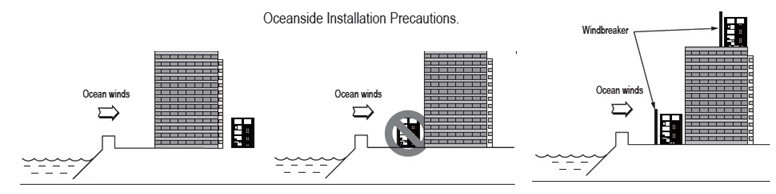
- Don’ts: * Do not install the unit in an area where combustible gas may generate, flow, stagnate, or leak. These conditions can cause a fire. * Do not install the unit in a location where acidic solution and spray (sulfur) are often used or in environments where oil, steam, or sulfuric gas are present. * A location that allows for optimum air flow and is easily accessible for inspection, maintenance, and Where piping between the outdoor unit and indoor unit(s) / heat recovery units are within allowable Limits. * Avoid placing the outdoor unit in a low-lying area where water could accumulate. * If the outdoor unit is installed in a highly humid environment (near an ocean, lake, etc.), ensure that the…