
9. Measurement of LUX Level and Uniformity at Indoor and Outdoor Lighting (Part-1)
MEASUREMENT OF LUX LEVEL AND UNIFORMITY AT INDOOR AND OUTDOOR LIGHTING (PART-1)
INTRODUCTION:
- Working plane illuminance (Lux Level) need to be measured in the field for cross check of whether the existing installation meets a design requirement or not. * Field surveys may also be useful to identifying the causes of complaints about lighting, hence the results of field surveys may be useful for the designer, installers and end users. * There are various methods are developed for field measurement of Interior Lighting and External Lighting. * The Measurement Methods recommended by the various national lighting bodies are generally similar or slightly derivatives to each other. The most common method / Standard is BEE, CIBSE, IES and DIN code * The most of methods require to measurement of illuminance at points on a grid at working-plane height or at Floor, but the grid size and position of the measuring points may be differed from various standard to standard. * The IES method and its derivatives use the position of the grid according to the luminaire locations. * The CIBSE and DIN methods use a position of grid according to the room size. * The techniques of analysis of the field measurement results also differ
BASIC REQUIREMENTS FOR EXTERIOR & INTERIOR LIGHT LEVEL MEASUREMENT
- The following Points should be considered for accurate measurement of interior and exterior lighting Lux level. * Where possible, use the same calibrated illuminance measurement meter (LUX Meter) If the same meter is not available, use the same make and model of calibrated meter to minimize error. * When taking measurements, verify that any objects/materials are not blocking any light to the meter head. The use of a remote meter head cabled to the meter body is recommended to prevent the operator from blocking the meter’s “view” of the lighting system being measured. * In Outdoor Lighting it is essential to measure of illuminance should be done in night (proper dark). * For indoor lighting, measurements with lights ON and Lights OFF technique can be followed and the daylight variation is not too much and the survey time is not too long. * In an installation of fluorescent discharge lamps, the lamps must be switched on at least 30 minutes before the measurement to allow for the lamps to be completely warmed up. * In many situations, the measuring plane may not be specified or even non-existent. Hence it is necessary to define measurement height, typically 0.8 to 1 meter from the ground or floor level. * The lux measurement procedure simply requires positioning a meter’s sensor on the surface or location where you wish to measure the incident light. * The sensor should face the light source at a right angle. If the sensor is not perpendicular to the light, the measurement will be incorrect, though some lux meters have a cosine correction to account for the angle. * Meters that require a colour correction factor may have a means of inputting the CCF to adjust the result for LEDs or fluorescent lights; otherwise, you will have to manually multiply the measured lux by the CCF.
INDOOR ILLUMINATION (LUX LEVEL) MEASUREMENT.
(1) AS PER ROOM INDEX METHOD (AS PER BEE CODE / CIBSE CODE):
- This methos is more suitable where measuring Plan / Points for an interior is more rectangular than square. First, we need to be found Room Index. * Based on the room index, the minimum number of illuminance measurement points is decided by Room Index Number * Room Index (RI) = (L x W) / H x (L+ W) * Where L = Length of Room * W = Width of Room * H= Height of the luminaires above the plane of measurement
Table 4-2: Number of points for measuring illuminance
Room index
Minimum number of measurement points
For ± 5% accuracy
For ± 10% accuracy
RI < 1
8
4
1 < RI < 2
18
9
2 < RI < 3
32
16
RI > 3
50
25
Sample calculation
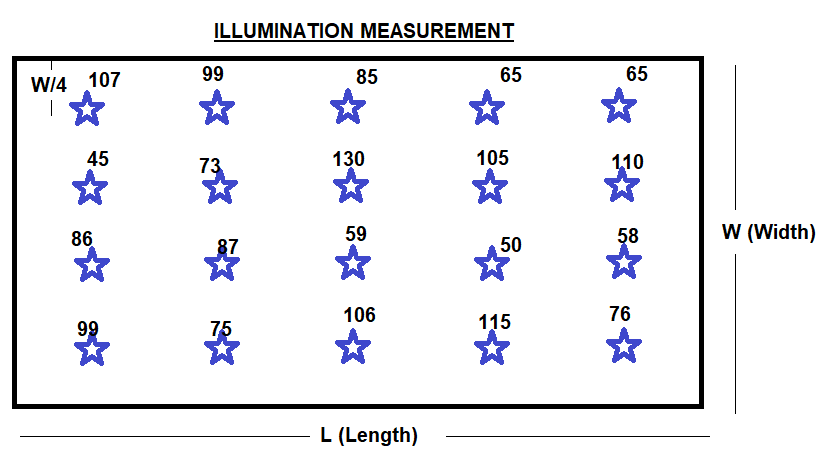
- Measure Illumination Level of an office room have length, L = 7.5 m and width W = 5 m, * Solution: * Suppose Height of Illumination from Floor is 2 Meter * Room Index RI = (L x W) / H x (L+ W) * Room Index RI = (7.5 x 5) / 2 x (7.5+ 5) * Room Index RI = 1.5 * From Table 4.2 minimum Illumination Measure Points should be 18 No’s * The illuminance measurements Points with Measured Value in Lux are marked on the grid.
1
Measurement Reading Details
107 Lux
99 Lux
85 Lux
65 Lux
65 Lux
45 Lux
73 Lux
130 Lux
105 Lux
110 Lux
86 Lux
87 Lux
59 Lux
50 Lux
58 Lux
99 Lux
75 Lux
106 Lux
115 Lux
76 Lux
Min
45 Lux
Max
130 Lux
Average
85 Lux
U1=MIN/AVG
0.5 Lux
U2=MIN/MAX
0.3 Lux
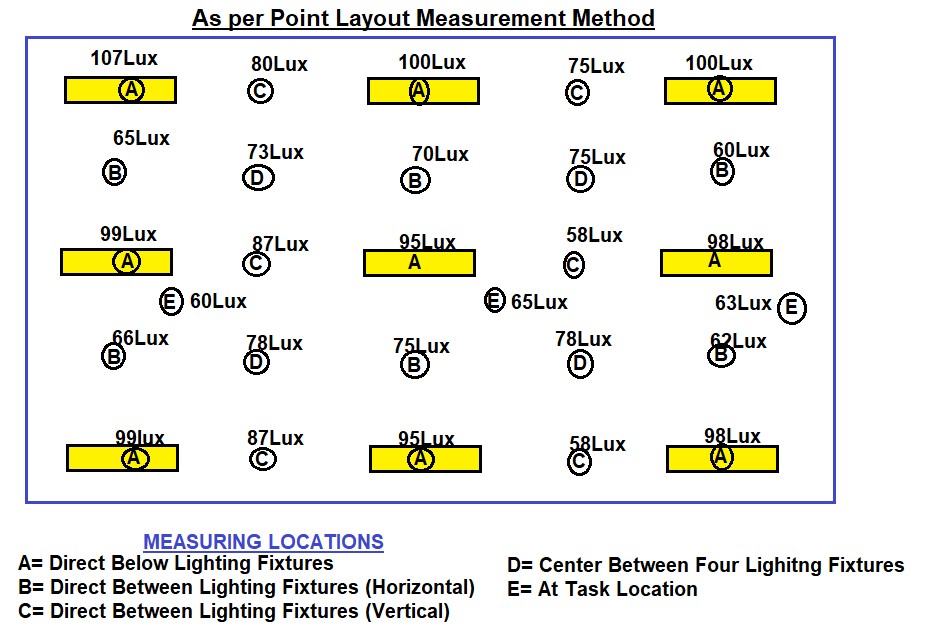
(2) AS PER POINT LAYOUT METHOD
- For office and other task areas, identify a set of measurements points on desktops and other work surfaces that best represents lighting conditions in the space. * It may not be possible to develop a uniform spacing grid, but points should be chosen that represent the various lighting c…