


Types and Revolution of Electrical Relays
TYPES AND REVOLUTION OF ELECTRICAL RELAYS
INTRODUCTION:
- Protective relays work in concert with sensing and control devices to accomplish their function. Under normal power system operation, a protective relay remains idle and serves no active function. But when fault or undesirable condition arrives Relay must be operated and function correctly. * A Power System consists of various electrical components like Generator, transformers, transmission lines, isolators, circuit breakers, bus bars, cables, relays, instrument transformers, distribution feeders, and various types of loads. Faults may occur in any part of power system as a short circuit & earth fault. Fault may be Single Line to Ground, Double Line to Ground, Line to Line, three phase short circuit etc. This results in flow of heavy fault current through the system. Fault level also depends on the fault impedance which depends on the location of fault referred from the source side. To calculate fault level at various points in the power system, fault analysis is necessary. * The protection system operates and isolates the faulty section. The operation of the protection system should be fast and selective i.e. it should isolate only the faulty section in the shortest possible time causing minimum disturbance to the system. Also, if main protection fails to operate, there should be a backup protection for which proper relay co-ordination is necessary. Failure of a protective relay can result in devastating equipment damage and prolonged downtime.
WORKING OF PROTECTIVE SCHEME:
- Protective relaying senses the abnormal condition in a part of power system and gives an alarm or isolates that part from healthy system. Protective relaying is a team work of CT, PT, protective relays, time delay relays, trip circuits, circuit breakers etc. * Protective relaying plays an important role in minimizing the faults and also in minimizing the damage in the event of faults.
1
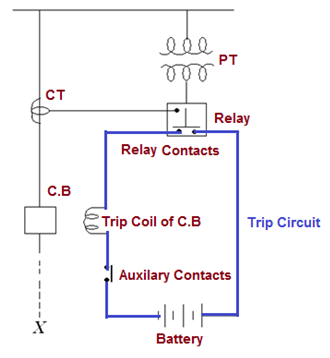
- Figure shows basic connections of circuit breaker control for the opening operation. The protected circuit X is shown by dashed line. When a fault occurs in the protected circuit the relay connected to CT and PT actuates and closes its contacts. * Current flows from battery in the trip circuit. As the trip coil of circuit breaker is energized, the circuit breaker operating mechanism is actuated and it operates for the opening operation. Thus the fault is sensed and the trip circuit is actuated by the relay and the faulty part is isolated.
WHAT IS RELAY:
- A relay is automatic device which senses an abnormal condition of electrical circuit and closes its contacts. These contacts in turns close and complete the circuit breaker trip coil circuit hence make the circuit breaker tripped for disconnecting the faulty portion of the electrical circuit from rest of the healthy circuit.
FUNCTIONS OF PROTECTIVE RELAY:
- To sound an alarm or to close the trip circuit of a circuit breaker so as to disconnect Faulty Section. * To disconnect the abnormally operating part so as to prevent subsequent faults. For e.g. Overload protection of a machine not only protects the machine but also prevents Insulation failure. * To isolate or disconnect faulted circuits or equipment quickly from the remainder of the system so the system can continue to function and to minimize the damage to the faulty part. For example – If machine is disconnected immediately after a winding fault, only a few coils may need replacement. But if the fault is sustained, the entire winding may get damaged and machine may be beyond repairs. * To localize the effect of fault by disconnecting the faulty part from healthy part, causing least disturbance to the healthy system. * To disconnect the faulty part quickly so as to improve system stability, service continuity and system performance. Transient stability can be improved by means of improved protective relaying. * To minimize hazards to personnel
DESIRABLE QUALITIES OF PROTECTIVE RELAYING:
- Selectivity, 2. Discrimination 3. Stability 4. Sensitivity, 5. Power consumption 6. System Security 7. Reliability 8. Adequateness 9. Speed & Time
TERMINOLOGY OF PROTECTIVE RELAY:
- Pickup level of actuating signal: The value of actuating quantity (voltage or current) which is on threshold above which the relay initiates to be operated. If the value of actuating quantity is increased, the electromagnetic effect of the relay coil is increased and above a certain level of actuating quantity the moving mechanism of the relay just starts to move. * Reset level: The value of current or voltage below which a relay opens its contacts and comes in original position. * Operating Time of Relay: Just after exceeding pickup level of actuating quantity the moving mechanism (for example rotating disc…