

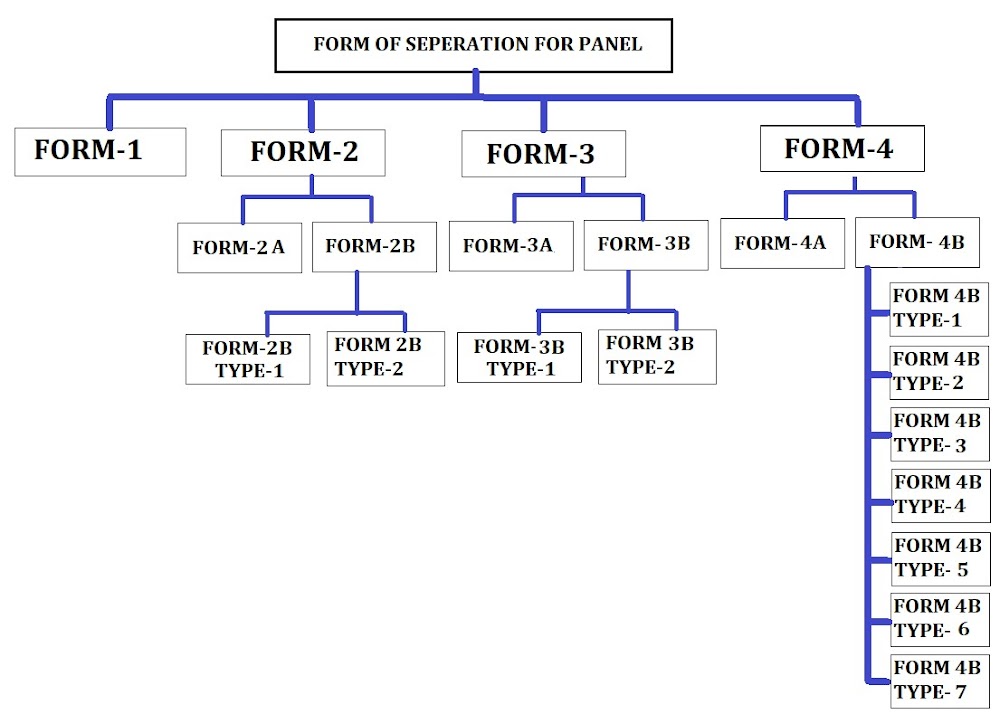

FORM of Separation for Panel- PART-1
FORMS OF SEPARATION FOR PANEL (PART-1)
INTRODUCTION:
- Forms of segregation have great importance in electrical Panel designs. * Form of segregation is the rule for provide separation from a one energizes function part to other energize function pant and access to a part of the assembly while other parts may remain energized. This can be achieved by using metallic or non-metallic physical barriers or insulation. * The form of segregation provides protection against four objectives.
- Protection against direct contact with live dangerous parts of adjacent functional units. 2. Protection against the entry of solid objects from one unit of an assembly to an adjacent unit. 3. Limitation of the effects of the spread of electric arcs. 4. Facilitation of panel maintenance operations.
TYPE OF SEPARATION:
- As specified by AS / NZS / IEC 61439, There are four main categories outlined by the standard for internally separating the switchgear units and busbars of a Panel are
- Form 1 (No segregation between busbar, terminals and Switchgear units) 2. Form 2 (Separation between switchgear units and the busbar) 3. Form 3 (Separation are between switchgear units and the busbar and Separation between Switchgear unit to Switchgear Unit) 4. Form 4 (Segregation between busbar, terminals and Switchgear units)
- The complexity of the forms increases with the numbers.
1
(A) FORM 1:
- A Form 1 Panel has no internal separation among busbar, switchgear and outgoing Cable Terminations. * All functional units are installed in one central section to provide protection against contact with any internal live parts. * Busbar and Switchgear: Bus bars are not separated from the Switchgear units, * Busbar and Termination: Bus bars are not separated from any incoming or outgoing terminations. * Switchgear and Switchgear units: Switchgear units are not separated from each other. * Switchgear and Termination: Switchgear units are not separated from any incoming or outgoing termination. * Termination and Termination: Incoming and outgoing terminals are not separated from each other
2
Advantage:
- Simple Design and Less Space Required.
Electrical Safety:
- Less due to No separation between live parts. * This form construction is rarely used.
Cost:
- Less Cost
Application:
- For small, low power switchboards.
(B) FORM 2
- Form 2a is the simplest for protecting against accidental contact with any internal live parts or components like the busbars, which are considered to be the most dangerous components. * In FORM-2, Busbar is Separate from the Switchgear units but may or may not be separate from Cable terminal. * Busbar and Switchgear: Bus bars are separated from the Switchgear units, * Busbar and Termination: Bus bars may or may not separate from any incoming or outgoing terminations. * Switchgear and Switchgear units: Switchgear units are not separated from each other. * Switchgear and Termination: Switchgear units are not separated from any incoming or outgoing termination. * Termination and Termination: Incoming and outgoing terminals are not separated from each other * This is further classified into 2 categories.
FORM 2A
- Terminals are not separated from the busbars or each other.
FORM 2B
- Terminals are separated from the busbars
FORM 2B TYPE 1
- As form 2 but Busbar separation is achieved by insulated coverings, e.g. PVC sleeving, wrapping or coating. * Terminals are the therefore separated from the busbars, but not from functional units or each other.
FORM 2B TYPE 2
- As from 2 but Busbar separation is achieved by metallic or non-metallic rigid barriers or partitions * Terminals are therefore separated from the busbars, but not from functional units or each other
3
Advantages:
- There are several advantages to segregating functional units and busbars. * This model allows circuit breakers to be reset when the switchboard is live because the operator is not exposed to a live busbar.
Electrical Safety:
- More than Form-1 due to separation between live parts (Busbar and Switchgear).
Cost:
- More Costly than Form-1
Application:
- For small, low power switchboards.