

Working Space for Electrical Equipment / Panel-PART-1
WORKING SPACE FOR ELECTRICAL EQUIPMENTS / PANELS (PART-1)
ELECTRICAL EQUIPMENT SPACE (AS PER NEC 110.26)
(A) WORKING SPACE:
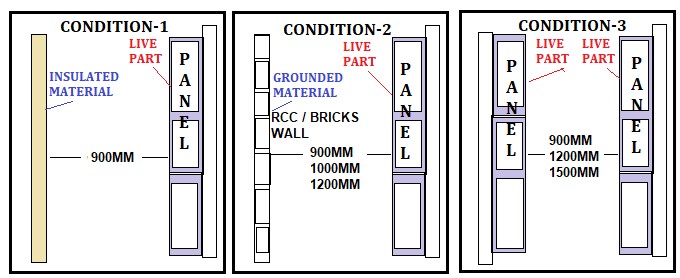
- Equipment that may need examination, adjustment, servicing, or maintenance while energized must have working space which is measured from the enclosure front, must not be less than the distances contained in Table 110.26(A)(1).
(1) DEPTH OF WORKING SPACE.
Table 110.26(A)(1) Working Space
Voltage-to-Ground One side of working Space having Pnel Exposed live parts and other side of Working Space having no live or grounded parts (including concrete, brick, or tile walls) One side of working Space having Panel Exposed live parts and other side of Working Space having live or grounded parts (including concrete, brick, or tile walls) Exposed live parts on both sides of the working space. 0 To 150V 3 Foot (900MM) 3 Foot (900MM) 3 Foot (900MM) 151V To 600V 3 Foot (900MM) 3.5 Foot (1000MM) 4 Foot (1200MM) 601V TO 1000V 3 Foot (900MM) 4 Foot (1200MM) 5 Foot (1500MM)
A
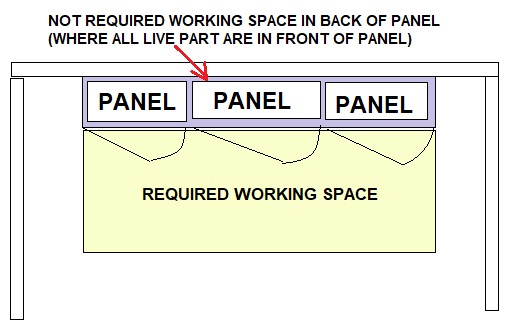
(a) Rear and Sides. Working space isn’t required for the back or sides of assemblies where all connections and all renewable or adjustable parts are accessible from the front.
(2) WIDTH OF WORKING SPACE.
- The width of the working space must be a minimum of 760MM (30 in) but in no case less than the width of the equipment. * The width of the working space can be measured from left-to-right, from right-to-left, or simply centered on the equipment, and the working space can overlap the working space for other electrical equipment. * In all cases, the working space must be of sufficient width, depth, and height to permit all equipment doors to open 90 degrees.
B
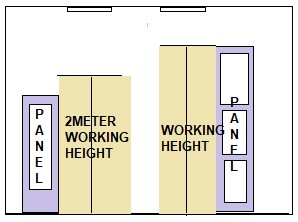
(3) HEIGHT OF WORKING SPACE (HEADROOM).
- The height of the working space in front of equipment must not be less than 2 Meter (6½ ft) measured from the grade, floor, platform, or the equipment height, whichever is greater. * Equipment such as raceways, cables, wireways, cabinets, panels, and so on, can be located above or below electrical equipment, but must not extend more than 6 in. into the equipment’s working space.
D
(B) LIMITED ACCESS
- Where equipment is installed above a lay-in ceiling, there shall be an opening not smaller than 559 mm × 559 mm (22 in. × 22 in.), or in a crawl space, there shall be an accessible opening not smaller than 559 mm × 762 mm (22 in. × 30 in.). * The width of the working space shall be the width of the equipment enclosure or a minimum of 762 mm (30 in.) whichever is greater. * All enclosure doors or hinged panels shall be capable of opening a minimum of 90 degrees. * The space in front of the enclosure shall comply with the depth requirements of Table 110.26(A)(1). * The maximum height of the working space shall be the height necessary to install the equipment in the limited space. A horizontal ceiling structural member or access panel shall be permitted in this space.
(C) ENTRANCE TO AND EGRESS FROM WORKING SPACE.
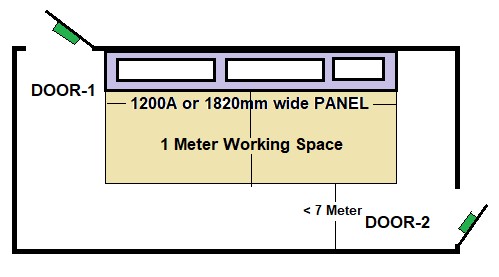
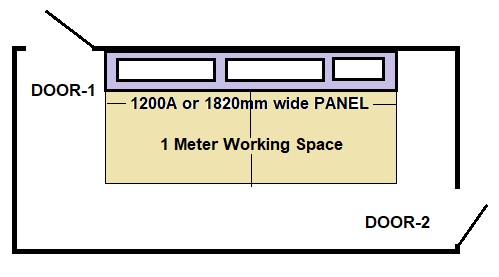
- (1) Minimum Required: At least one entrance of sufficient area must provide access to and egress from the working space. * (2) Large Equipment: An entrance to and egress from each end of the working space of for electrical equipment rated 1,200A or more and over 6 ft wide is required an entrance of Not Less than 600MM Wide and 1800MM Height at each end of Working Place.
E
- A single entrance to and egress from the required working space is permitted where either of the following conditions is met: * (a) Unobstructed Egress. Only one entrance is required where the location permits a continuous and unobstructed way of egress travel. * (b) Double Workspace. Only one entrance is required where the required working space depth is doubled, and the equipment is located so the edge of the entrance is no closer than the required working space distance.
F
- (3) Personnel Doors: If equipment with overcurrent or switching devices rated 1,200A or more is installed, personnel door(s) for entrance to and egress from the working space located less than 25 ft from the nearest edge of the working space must have the door(s) open in the direction of egress and be equipped with panic hardware or other devices that open under simple pressure
G